Itchan Kala
First-timersSleep inside the walls and you can walk the empty streets at dawn and after dark. Guests don't need a ticket just to go in and out.

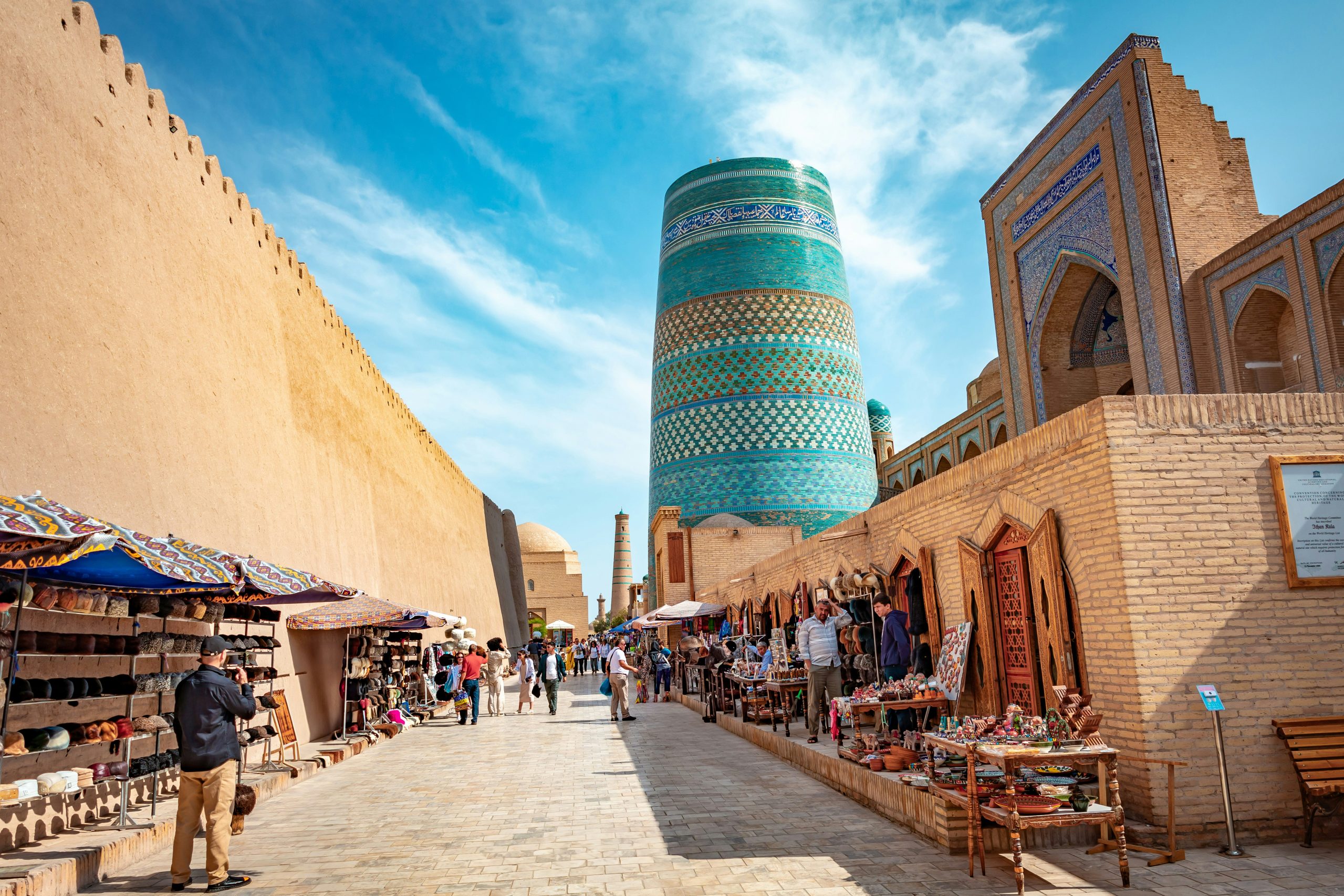
A walled city preserved end to end, with turquoise minarets, palaces and a mosque of carved wooden pillars, best at dawn or after the day groups leave.
Khiva was the capital of a khanate on the edge of the Kyzylkum desert, and for centuries one of the most feared stops on the caravan routes, with a slave market at its gate. Its walled inner town, Itchan Kala, survived almost intact: about 1 km across, packed with madrasas, minarets, palaces and mosques. It is a UNESCO World Heritage Site.
By day it can feel like an open-air museum, with tour groups and souvenir stalls. Before 8am and after sunset it turns back into a quiet desert town, which is why it is worth sleeping inside the walls.
Two days is right: one in the old town, and one for the ruined desert fortresses of ancient Khorezm, about an hour and a half away.
Stay inside Itchan Kala, the walled town.
Sleep inside the walls and you can walk the empty streets at dawn and after dark. Guests don't need a ticket just to go in and out.
Orange labels are neighbourhoods, dots are the 2 top-rated hostels. Map data from OpenStreetMap contributors.
Buy the Itchan Kala ticket at the West Gate (Ota Darvoza). It costs 100,000 som (about €7), is valid for one day, and covers most of the museums and madrasas. A few sights charge separately: the Islam Khodja minaret, the tallest in Khiva, is 30,000 som to climb, and the Pahlavon Mahmud mausoleum is 25,000. Sights open from 8am to sunset in summer and from 9am in winter.
Start with Kalta Minor, the fat, unfinished turquoise minaret by the West Gate, then the Kunya Ark, the khans' fortress, whose watchtower is the classic spot for sunset over the rooftops.
Walk into the Juma Mosque, a dim hall held up by more than 200 carved wooden columns, some about a thousand years old. Then see the tiled harem courtyards of the Tosh-Hovli Palace and the blue-domed Pahlavon Mahmud mausoleum, Khiva's most revered shrine.
Climb the Islam Khodja minaret late in the afternoon, then walk a stretch of the mud-brick walls. On your second day, drive out to the desert fortresses of Ayaz Kala and Toprak Kala, about an hour and a half away. A private car starts at about $40.
Walking inside the walls is free. You only need the ticket to go into the monuments, and if you stay in Itchan Kala you can come and go without one.
The best of Khiva costs nothing. At dawn the streets are empty and the light turns the mud walls gold, and once the day groups leave in the evening the old town goes quiet.
Just outside the East Gate (Palvan Darvoza), the bazaar is where locals shop for bread, melons and spices. The view of the walls and the West Gate from outside is free too.
Khorezm has its own dishes. Try shivit oshi, bright green dill noodles with meat stew and yoghurt; tuxum barak, dumplings filled with egg; and gumma, fried pastries sold on the street. Plov and shashlik are everywhere.
Several restaurants by Kalta Minor and the West Gate have rooftop terraces with views over the minarets. The food costs a little more, and the view is the reason to go.
In late summer, Khorezm melons from the bazaar outside the East Gate are famous across Uzbekistan. A meal is €3 to €8 (about 40,000 to 110,000 som).
Khiva goes quiet once the sun sets, and that is the appeal. The evening plan is dinner on a rooftop terrace, then a walk through the empty, lit-up streets.
Some restaurants serve beer and local wine, at €2 to €4 for a beer. The desert sky is clear most of the year, so look up on the way home.
The Jaloliddin Manguberdi high-speed train, running since May 2026, connects Tashkent and Khiva in about 7.5 hours, stopping at Samarkand, Bukhara and Urgench. It leaves Tashkent on Tuesdays, Thursdays and Saturdays and comes back on Wednesdays, Fridays and Sundays. Tickets go on sale 30 to 45 days ahead on the Uzbekistan Railways website or app, and they sell out. The overnight sleeper train still runs and takes about 14 hours from Tashkent.
Khiva station is a 20-minute walk from the old town, or about 15,000 som by taxi. Urgench Airport is 30 to 40 minutes away, about 150,000 som by taxi.
Shared taxis cross the desert to Bukhara in six to seven hours, and reach Nukus in about three.
Khiva is cheap. Dorms start around €8 and a careful day costs €20 to €30. On top of that you'll pay 100,000 som (about €7) for the Itchan Kala ticket, plus small extras for the minaret and the mausoleum.
A private car to the desert fortresses starts at about $40 for the day, so it's worth finding others to share it.
The currency is the som (UZS): about 13,700 to the euro, paid in thick bundles of notes. The ticket office takes cards, but carry cash for food, taxis and the extras.
Khiva is very safe. Your accommodation registers you with the authorities; keep the registration slips, as they can be checked when you leave the country.
Summer is extremely hot, often above 35°C in July. See the sights early and late, and rest in the middle of the day. The fortresses have no shade at all.
Emergency: 102 police, 103 ambulance, 101 fire.
The dawn light on the walls is the daily event.
The spring new year.
Famous melons.
The top-rated places to stay in Khiva right now, live from Hostelworld.
Go in April and May or September and October. July and August are very hot, and winter is cold, with short opening hours.
Average highs. Very hot summers and cold winters.
Pick how you travel. Per person per night, in euros.
Prices are in som locally; these are euro equivalents. Excludes the monuments ticket.
The ones we get asked most.

Compare Khiva hostels — live prices, real reviews and free cancellation on most bookings. Then meet the people already there in the app.

 Get the App.
 Get the App.