Central Street
First-timersThe Russian-era street.

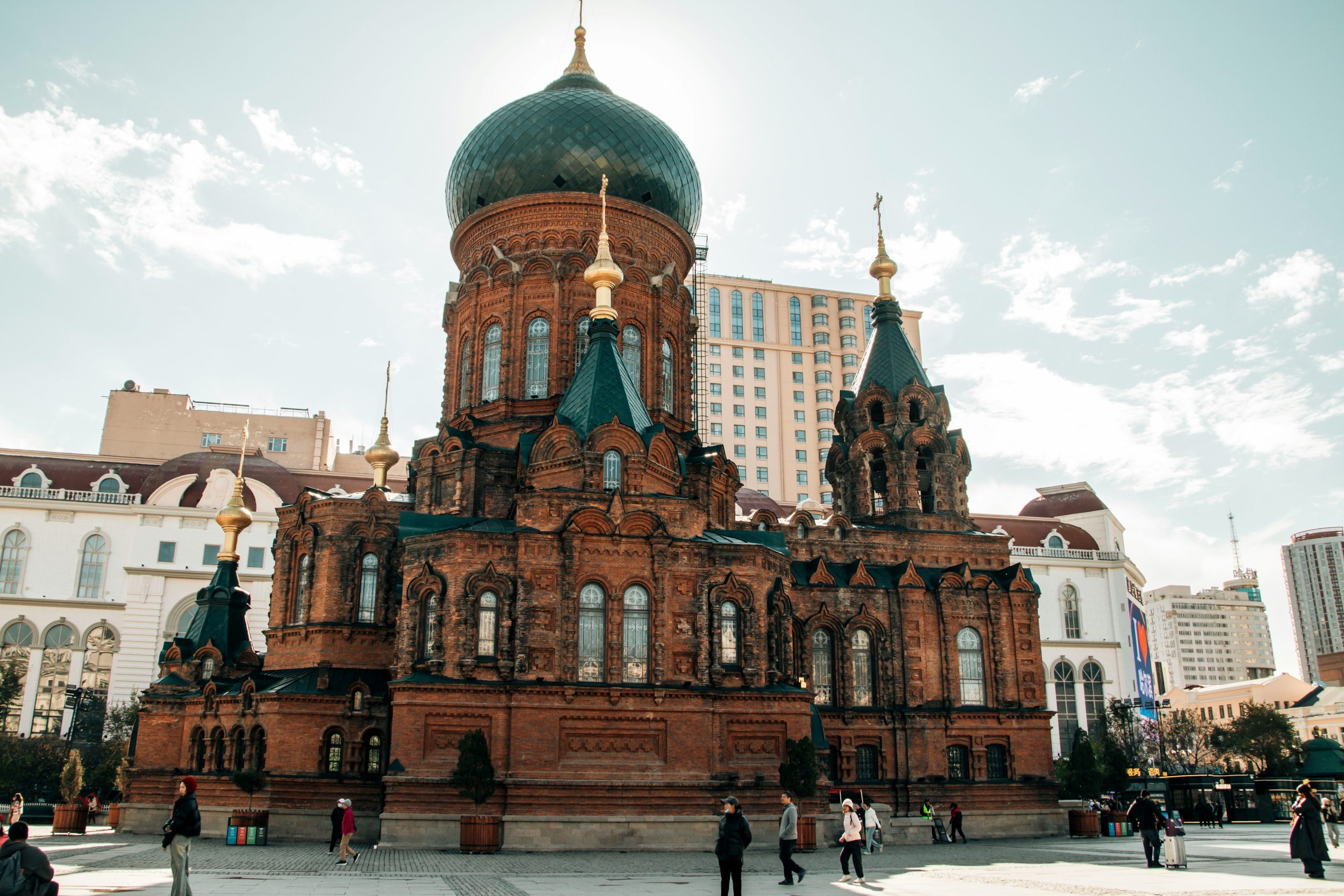
Russian domes and cobbled streets in China's far north-east, minus twenty in January, and the world's biggest ice festival, with buildings carved from the frozen river and lit up at night.
Harbin was built by Russia at the end of the nineteenth century as a station on the Chinese Eastern Railway, and for decades it was home to a large Russian community. Its onion-domed churches and cobbled Central Street still look more like Europe than China.
It is one of the coldest big cities in the world, and it makes the most of it. Each winter, the Harbin Ice and Snow Festival fills a site the size of a small town with palaces, castles and slides carved from blocks of ice cut from the Songhua river, lit in every colour at night.
Two or three days in winter is right.
Central Street, the Russian-era pedestrian street, is the best base, near St Sophia Cathedral and the Songhua river. The area around the railway station is cheaper and convenient for trains. In winter, staying central saves time in the cold.
The Russian-era street.
The frozen river.
Orange labels are neighbourhoods, dots are the 4 top-rated hostels. Map data from OpenStreetMap contributors.
Harbin, in China's far north-east, was built by Russians around the Trans-Manchurian railway in the late nineteenth century, and its architecture still shows it. In winter it hosts one of the world's great festivals of ice.
The Harbin Ice and Snow World, open from about late December to February, is a city of giant buildings carved from blocks of river ice, lit in neon colours at night; go at dusk to see it lit. Sun Island has huge snow sculptures, and Zhaolin Park has ice lanterns.
Walk Central Street, a cobbled pedestrian street of Russian and art nouveau buildings, and see St Sophia Cathedral, a green-domed Russian Orthodox church built in 1907, now a museum. In winter, the frozen Songhua river becomes a playground of ice slides, skating and horse sleighs.
The Siberian Tiger Park breeds rare Siberian tigers, viewed from a bus. Unit 731, the museum of a Japanese wartime germ-warfare base, is a sobering visit.
Yabuli, China's biggest ski resort, is about three hours away, and Snow Town, a village buried in deep snow, about five.
Central Street and St Sophia's exterior are free, and so is walking on the frozen Songhua river in winter.
The Unit 731 museum is free with a reservation, and Zhaolin Park's ice lanterns charge a small fee.
Harbin's food mixes north-eastern Chinese and Russian. Guobaorou, sweet-and-sour crispy pork, was invented here. Dongbei dumplings, hearty stews and Harbin red sausage are local favourites.
Russian bread, the huge round dalieba, and ice cream eaten outside in minus 20 degrees are Harbin traditions. Harbin beer, first brewed in 1900, is China's oldest. A meal is €4 to €12.
Harbin's nightlife centres on Central Street, with Russian-style bars, and the Ice and Snow World, which is best at night.
A beer is €2 to €5; Harbin beer is the local choice.
Harbin Taiping Airport is about 40 minutes from the centre. High-speed trains reach Beijing in about six to seven hours.
The metro covers the city, and taxis and Didi are cheap. In winter, buses run to the Ice and Snow World; taxis are easier in the cold.
Harbin is mid-priced, with prices rising in festival season. Dorms start around €10 and a careful day is €30 to €45.
The Ice and Snow World is about €40 to €50, Sun Island's snow sculptures about €30, and the Siberian Tiger Park about €12.
The currency is the yuan (CNY), at roughly 8 yuan to the euro; prices here are euro equivalents. Almost everyone pays by phone: set up Alipay or WeChat Pay with a foreign card before you arrive, and carry some cash as a backup.
Harbin is safe.
The cold is extreme: January temperatures often fall below -20°C and can reach -30°C. Dress in many layers, cover your face and extremities, and keep phone batteries warm, as they die quickly. Pavements are icy.
Google, WhatsApp and Instagram are blocked; use an eSIM with international roaming, and Amap or Baidu Maps for directions. Carry your passport: it is needed for trains, hotels and many sights, which are booked by real name.
Many nationalities can now enter China visa-free for up to 30 days, under a scheme extended to the end of 2026, and 240-hour visa-free transit covers many more; check the rules for your passport before you travel.
Emergency: 110 police, 120 ambulance, 119 fire.
The Ice and Snow Festival is one of the biggest winter festivals in the world.
Illuminated ice buildings.
Beer gardens across the city.
The top-rated places to stay in Harbin right now, live from Hostelworld.
December to February for the ice festival; summer for the beer festival.
Average highs. January is regularly minus twenty or colder.
Pick how you travel. Per person per night, in euros.
Prices are in yuan locally; these are euro equivalents. Excludes the ice festival ticket.
The ones we get asked most.

Compare Harbin hostels — live prices, real reviews and free cancellation on most bookings. Then meet the people already there in the app.

 Get the App.


 Get the App.