Mestia
First-timers and trek baseThe main town: guesthouses, towers, the museum, jeep hire and the trailheads.

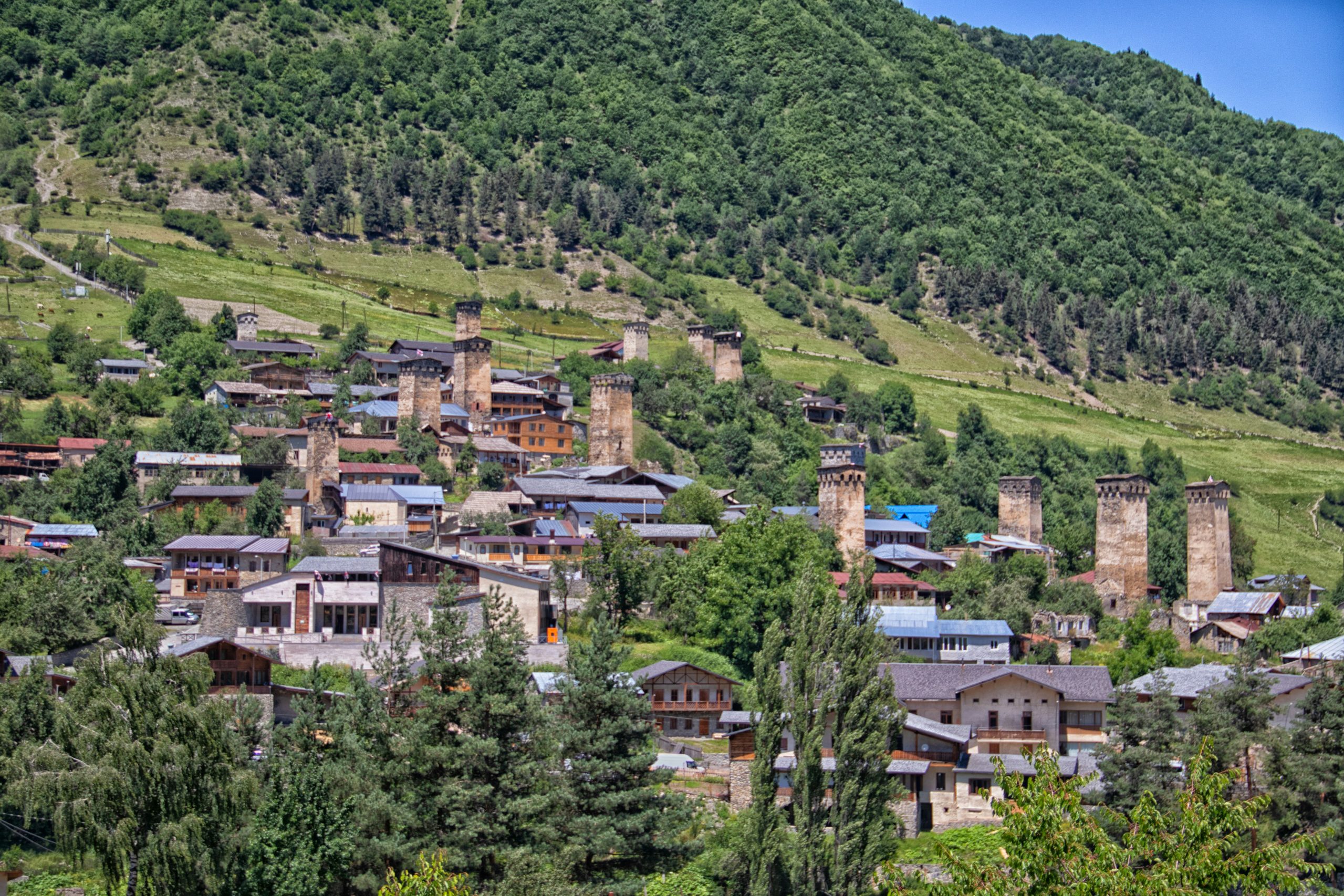
The Svaneti base: medieval stone defensive towers in every village, glaciers at the end of the valleys, and the best trekking in the Caucasus.
Svaneti sits in the high Caucasus in Georgia's north-west, cut off for much of the year until the road improved, and it kept a distinct language, culture and architecture as a result. Svan is spoken here and is not mutually intelligible with Georgian.
The towers are the signature. Built between the ninth and thirteenth centuries, stone, square and tapering, they were family refuges during blood feuds and raids, and more than two hundred still stand across the region. Mestia has dozens; Ushguli, higher up the valley, is UNESCO-listed for them.
The trekking is the best in the country. The Mestia to Ushguli route takes four days through villages, over passes and past glaciers, staying in guesthouses each night — no tent needed.
Day walks from Mestia reach the Chalaadi glacier and the Koruldi lakes, with Ushba, one of the hardest peaks in the Caucasus, dominating everything.
Three nights minimum, and the season is roughly May to October.
A small town in a high valley, with villages further up it.
The main town: guesthouses, towers, the museum, jeep hire and the trailheads.
Two hours further up the valley: UNESCO-listed towers at 2,100 m under Shkhara, with basic guesthouses.
Map © MapTiler © OpenStreetMap contributors.
Trek to Ushguli. Four days, staying in village guesthouses each night, through Zhabeshi, Adishi and Iprari, over the Chkhutnieri Pass and past the Adishi glacier. You carry a daypack, not a tent, and it costs very little beyond the beds. It is the best multi-day walk in the country and it needs no guide, though river crossings at Adishi usually involve paying a horseman.
If you have less time, the Chalaadi glacier is a half-day walk from town along a river valley to the ice front.
The Koruldi lakes are a hard full day uphill from Mestia, or a 4x4 most of the way, with Ushba filling the sky behind them.
The Svaneti Museum of History and Ethnography, about 15 GEL, holds illuminated manuscripts, icons and gold work, and explains the towers properly.
And go inside a tower — several families in Mestia open theirs for a few lari.
Walking is free and is the entire point. The Chalaadi glacier walk, the Koruldi lakes climb and the trails towards Zhabeshi all cost nothing beyond your legs.
Mestia itself is free to walk, with dozens of towers standing among ordinary houses and a cross above the town reached in about forty minutes for the valley view.
The Mestia to Ushguli trek costs only the guesthouse beds — there is no permit, no fee and no guide requirement.
Ushguli's towers, the highest village group in the region, are free to walk among, with only the small museum charging.
Watching Ushba appear out of cloud in the evening is free and is what everyone with a guesthouse balcony does.
Guesthouse cooking again, and it is the best option — dinner is usually 25 to 40 GEL and arrives as several dishes.
Svan food is its own thing. Kubdari is the regional dish: bread stuffed with spiced chopped meat, and it is excellent. Tashmijabi is mashed potato beaten with melted cheese until it stretches, and it is as heavy as that sounds.
Svan salt, a herb and garlic blend, is on every table and is sold in the markets to take home.
Restaurants in Mestia are limited and charge 25 to 45 GEL for a meal.
Buy trail food before setting off — the villages on the trek have guesthouses but very little else, and prices rise the higher you go.
Effectively none, and nobody comes here expecting otherwise.
There are a couple of bars in Mestia and a beer is 6 to 12 GEL.
The evening is a guesthouse dinner with other walkers, homemade wine or chacha, and route comparisons for tomorrow.
In winter Hatsvali and Tetnuldi have skiing and there is a little more life in town, though Svaneti in January is a serious proposition rather than a holiday.
The nearest actual nightlife is Kutaisi or Tbilisi, both a long way down the mountain.
Getting here is the hard part. Marshrutkas run from Zugdidi in about three hours for around 30 GEL, and Zugdidi is reached by overnight train from Tbilisi — which is the standard route and works well.
Small propeller planes fly from Natakhtari near Tbilisi and from Kutaisi. They are cheap, spectacular and cancel frequently for weather, so do not rely on them for a connection.
Mestia itself is walkable.
For Ushguli, shared jeeps run in season for about 60 to 80 GEL per person return, taking two hours each way on a rough road. Marshrutkas do the route less reliably.
Chalaadi and the Koruldi lakes are reachable on foot from town, or by 4x4 for the latter.
Cheap to be in and awkward to pay for. Guesthouse beds are 30 to 70 GEL, roughly €10 to €25, usually with breakfast and often with dinner for a little more.
A meal is 25 to 45 GEL and a beer 6 to 12 GEL.
A day is €20 to €45.
The trek to Ushguli is remarkably cheap — four nights of guesthouses and food, no permit, no guide needed — and is the best value multi-day walk in this part of the world.
Bring cash from Zugdidi or Tbilisi. There are ATMs in Mestia but they run dry, card acceptance is limited, and in the trekking villages it is cash only without exception.
Svaneti is safe in terms of crime, and the risks here are mountains, weather and distance from help.
Mountain rescue is limited and far away. Tell your guesthouse your route and your expected return, every time.
Weather changes fast and the passes can be in cloud or snow well into June. The Chkhutnieri Pass on the Ushguli trek holds snow late, and the Adishi river crossing is genuinely hazardous when the meltwater is high — horsemen ferry walkers across for a fee and this is the sensible option rather than a tourist trap.
Phone coverage is patchy to absent in the valleys. Download offline maps before you leave Mestia.
The road up from Zugdidi is a mountain road with drops and rockfall, and drivers take it quickly.
Shepherd dogs guarding livestock are a real hazard on the trails — they are protecting flocks, not being aggressive for its own sake. Give them distance, do not run, and carry a stick if it helps your nerve. Emergency number is 112.
Glaciers, lakes and the highest villages in the Caucasus.
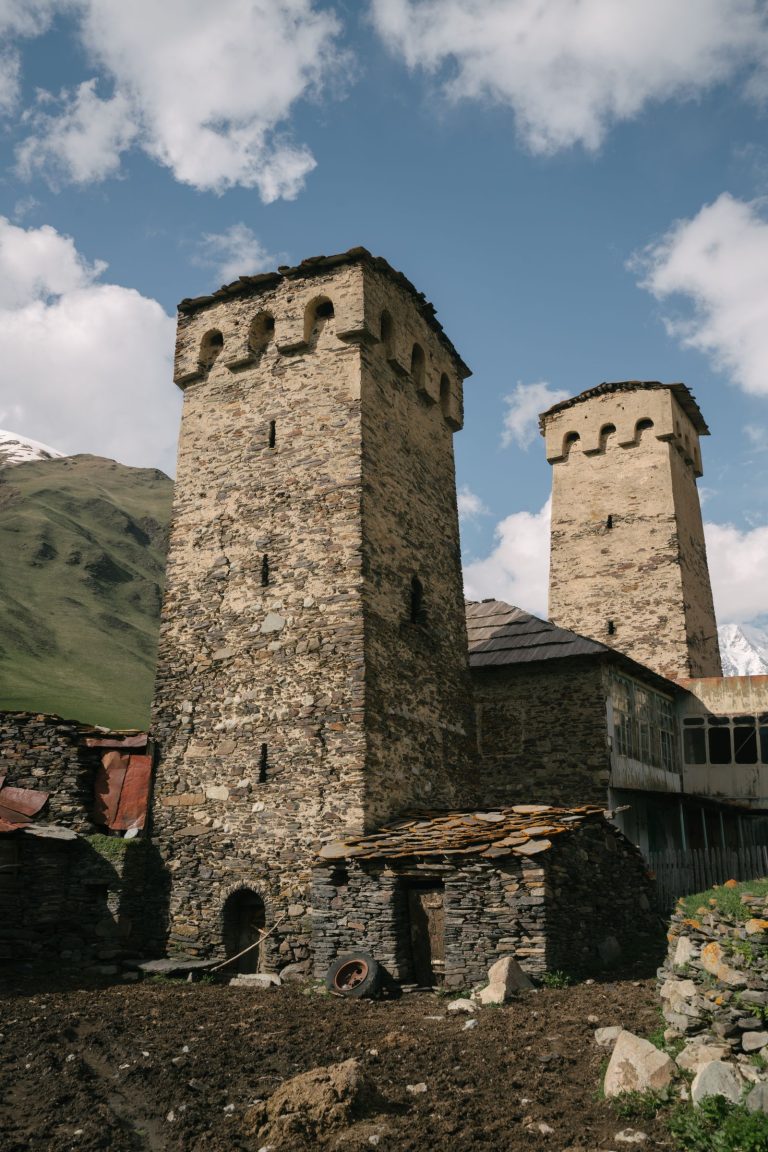
A UNESCO-listed cluster of tower villages at 2,100 m under Shkhara, Georgia's highest peak. Among the highest inhabited places in Europe.
A short trekking season and a long, hard winter.
When the passes are clear, the rivers are crossable and the village guesthouses are all open.
Two small resorts above the town, with serious off-piste and very few people.
A Svan festival of fire and remembrance, with torches carried through the villages at night.
A religious festival at a mountain church, one of the main events in the Svan calendar.
Between seasons, when many guesthouses shut and transport thins out.
July to September for trekking. The passes hold snow into June and much closes in winter.
Average highs in Mestia at about 1,500 m — it is much colder on the passes and at Ushguli. The Ushguli trek is realistically a July to September proposition, since the Chkhutnieri Pass holds snow and the Adishi river runs dangerously high earlier in the summer.
Pick how you travel. Per person per night, in euros.
Prices are shown in euros for comparison, but you will pay in lari and must bring it in cash. The shoestring doing line is zero because the trekking is free.
The ones we get asked most.

Compare Mestia guesthouses and hostels — live prices, real reviews and free cancellation on most bookings. Then meet the people already there in the app.

 Get the App.
 Get the App.