Stepantsminda
First-timersThe town: guesthouses, the marshrutka stop, a few restaurants and the view across to the church.

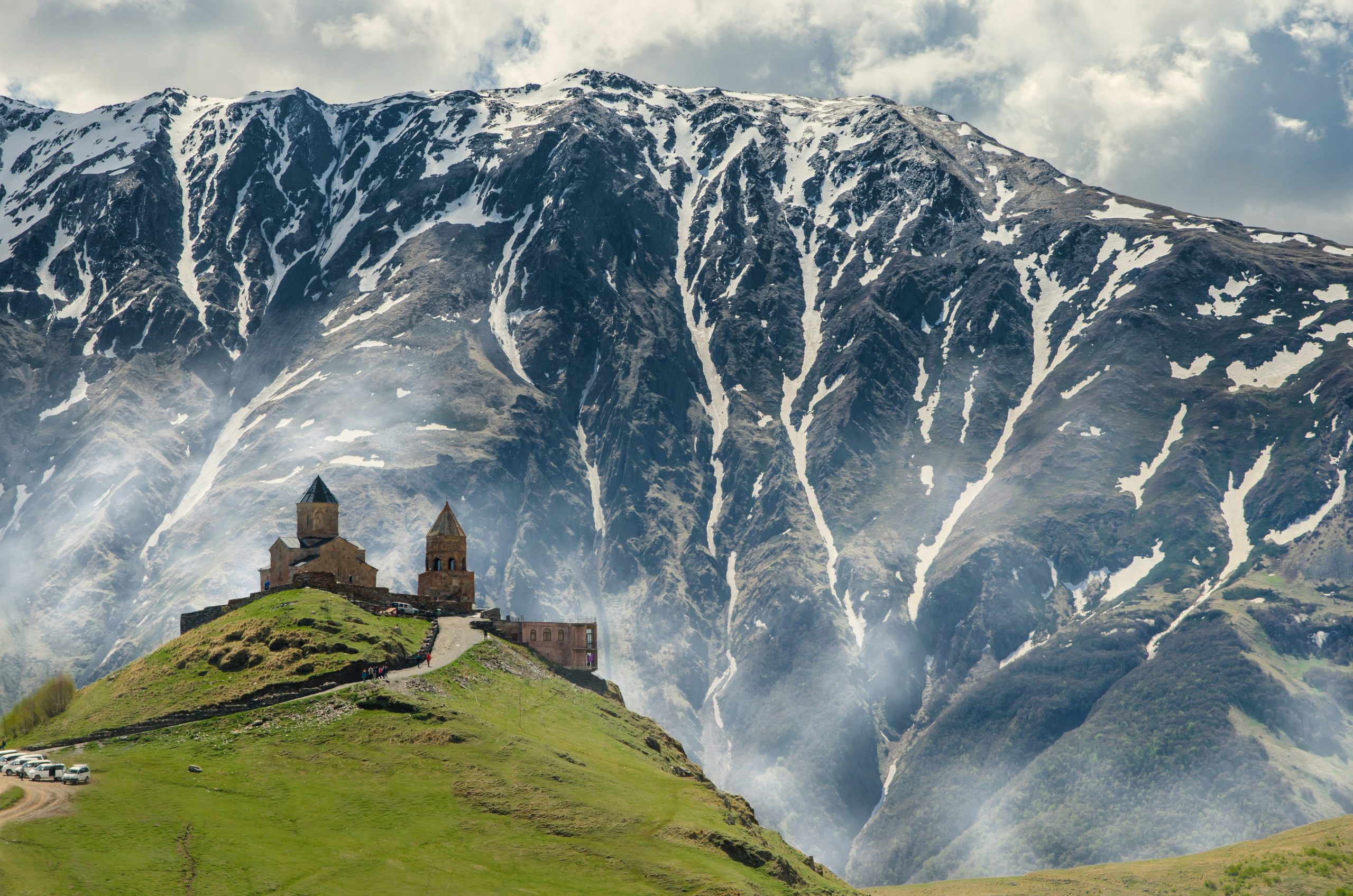
Stepantsminda, under a 5,000-metre peak, with a fourteenth-century church on the ridge above it and hiking in every direction.
The town is officially Stepantsminda and almost everyone calls it Kazbegi, after the mountain and the writer the region is named for. It sits at about 1,750 metres on the Georgian Military Highway, three hours north of Tbilisi and ten kilometres from the Russian border.
Above it, on a ridge at 2,170 metres, stands Gergeti Trinity church — fourteenth-century, isolated, and with Mount Kazbek rising to 5,054 metres behind it. It is the image that sells Georgia to the world and it is genuinely as good as the photographs.
The drive up is half the experience: the Georgian Military Highway climbs through the Jvari Pass at 2,379 metres past reservoirs, a Soviet friendship monument and a good deal of exposed mountainside.
Beyond the church, the hiking is the point — Juta, the Truso valley, the Gergeti glacier.
Two nights. Doing it as a day trip from Tbilisi means six hours in a minibus for two hours on the ground.
A small town on one side of a river, with a village up the hill opposite.
The town: guesthouses, the marshrutka stop, a few restaurants and the view across to the church.
The village across the river and up the slope, quieter and a shorter walk to the Trinity church.
Map © MapTiler © OpenStreetMap contributors.
Walk up to Gergeti Trinity church. It takes about an hour and a half to two hours from the town, climbing roughly 400 metres through forest and then open slope, and it is free. The alternative is a 4x4 taxi at 50 to 80 GEL for the car. Walking up and taking a taxi down is a reasonable compromise.
The church is fourteenth-century, still in use, and modest dress is expected — shoulders and knees covered, and a headscarf for women, usually available at the door.
Beyond it, the trail continues towards the Gergeti glacier and the Kazbek base camp at the Meteo Station, which is a serious full-day walk at altitude.
Juta, an hour away by 4x4, is a village at 2,200 metres below the Chaukhi massif, with a day hike to the Chaukhi Pass.
The Truso valley, west along a gorge, has mineral springs, travertine terraces, abandoned villages and defensive towers.
The walk up to Gergeti Trinity church is free and is the main event — an hour and a half to two hours each way, and the view back down the valley improves the whole way.
The church itself is free to enter, with modest dress expected.
The Sno valley, the river paths around the town and the walk into Gergeti village all cost nothing.
Watching the mountain is free and, on a clear morning, is what everyone here is doing. Kazbek is often hidden by cloud for days at a time, so the mornings tend to be the best chance.
The Soviet friendship monument at the Jvari Pass, on the drive up, is free and covered in mosaics, with a drop below it that no railing does much about.
Guesthouse cooking is the best food here by a distance. Most places do dinner for 25 to 40 GEL and it is usually a small supra — several dishes, homemade wine, and more than you can eat.
Mountain Georgian food is heavier than the lowland version: khinkali, which originated in these mountains, plus potato, cheese and lamb.
The restaurants in town are limited in number and adequate rather than good, at 25 to 45 GEL for a meal.
There is a small supermarket for trail food, and you should buy what you need before heading to Juta or Truso, where there is very little.
Homemade chacha appears at guesthouse dinners and is strong, often 50 per cent or more.
There is none, and that is the correct answer.
Kazbegi is a hiking base of a few thousand people. The evening is dinner at your guesthouse, homemade wine, conversation with whoever else is there, and an early night because the walk starts early.
A handful of bars and restaurants in town serve beer at 6 to 12 GEL.
In winter, Gudauri — the ski resort half an hour back down the highway — has the après scene, and a lot of people base there instead.
If you want a night out, it is three hours back to Tbilisi.
Marshrutkas leave Tbilisi's Didube station through the morning, take about three hours and cost around 15 GEL. They fill and go rather than running to a timetable, so arrive early.
The town itself is small enough to cross in ten minutes.
4x4 taxis are the local industry. Up to Gergeti church is 50 to 80 GEL for the car, Juta about 100 to 150 GEL return, and Truso similar. Prices are per vehicle, so a group splits them well.
The Georgian Military Highway is the only road, and it closes in winter for snow and avalanche risk — sometimes for days. Check the situation before travelling between November and April.
The Russian border is ten kilometres north at Dariali. It is a functioning crossing but the political situation makes it a poor plan for most visitors.
Cheap, with transport as the main variable. Dorms and guesthouse beds are 30 to 70 GEL, roughly €10 to €25, usually with breakfast.
A guesthouse dinner is 25 to 40 GEL and a beer 6 to 12 GEL.
A day is €20 to €45.
The walking is free. The costs are 4x4 hires — 50 to 80 GEL to the church, 100 to 150 GEL for Juta or Truso — and they are priced per vehicle, so travelling with others makes a large difference.
Bring cash. There are ATMs in town but they run out, card acceptance is patchy, and there is nothing at all in the valleys.
This is a high mountain area and the risks are weather, altitude and the road rather than crime.
The walk to Gergeti church climbs 400 metres to 2,170, which is enough for some people to feel the altitude. Go slowly and drink water. Anything beyond the church — the glacier, the Meteo Station — is a serious mountain undertaking and should not be attempted casually or alone.
Weather changes fast and cloud can close in within minutes, making the open slope above the treeline disorienting. Take layers and waterproofs whatever the morning looks like.
The Georgian Military Highway is genuinely dangerous: mountain switchbacks, heavy Armenian and Russian truck traffic, and drivers who overtake into blind bends. Sit near the front, and ask the driver to slow down if you need to — it is normal and it works.
In winter the road closes for snow and avalanche. Do not plan tight connections around it.
There is no mountain rescue service comparable to the Alps. Tell your guesthouse your route. Emergency number is 112.
Valleys, passes and a ski resort, all within an hour.
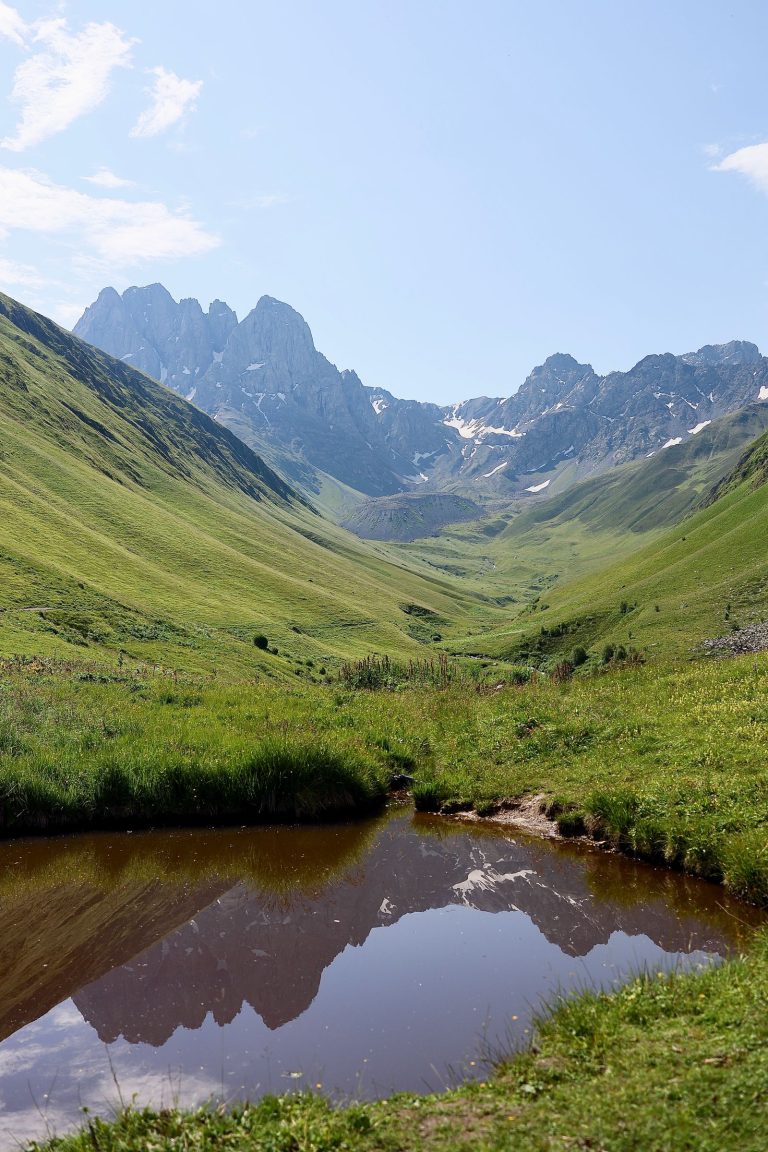
A village at 2,200 m under the Chaukhi massif, with a day hike up to the Chaukhi Pass and back.
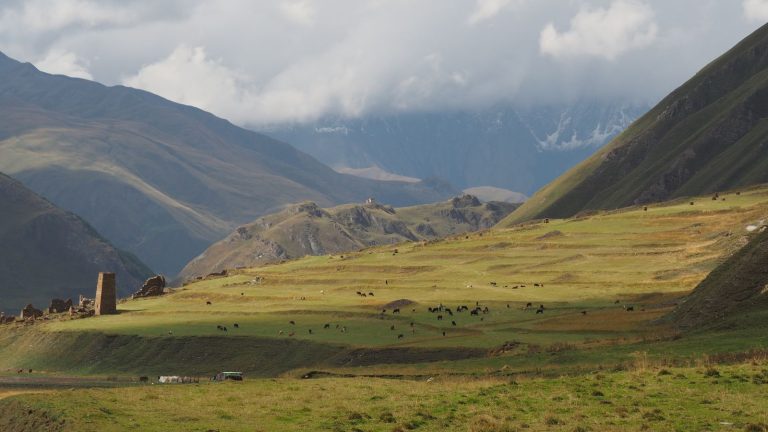
A gorge with mineral springs, travertine terraces, abandoned villages and defensive towers.
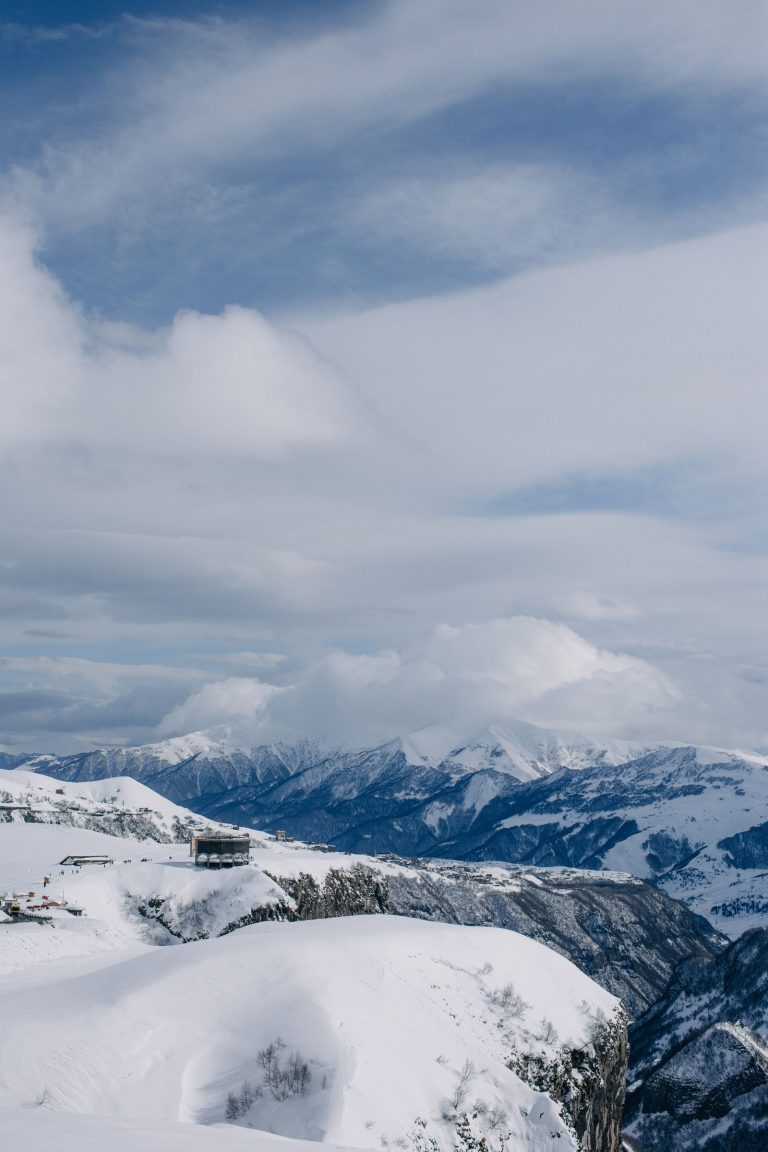
Georgia's main ski resort, with the Soviet friendship monument and its mosaics on the way.
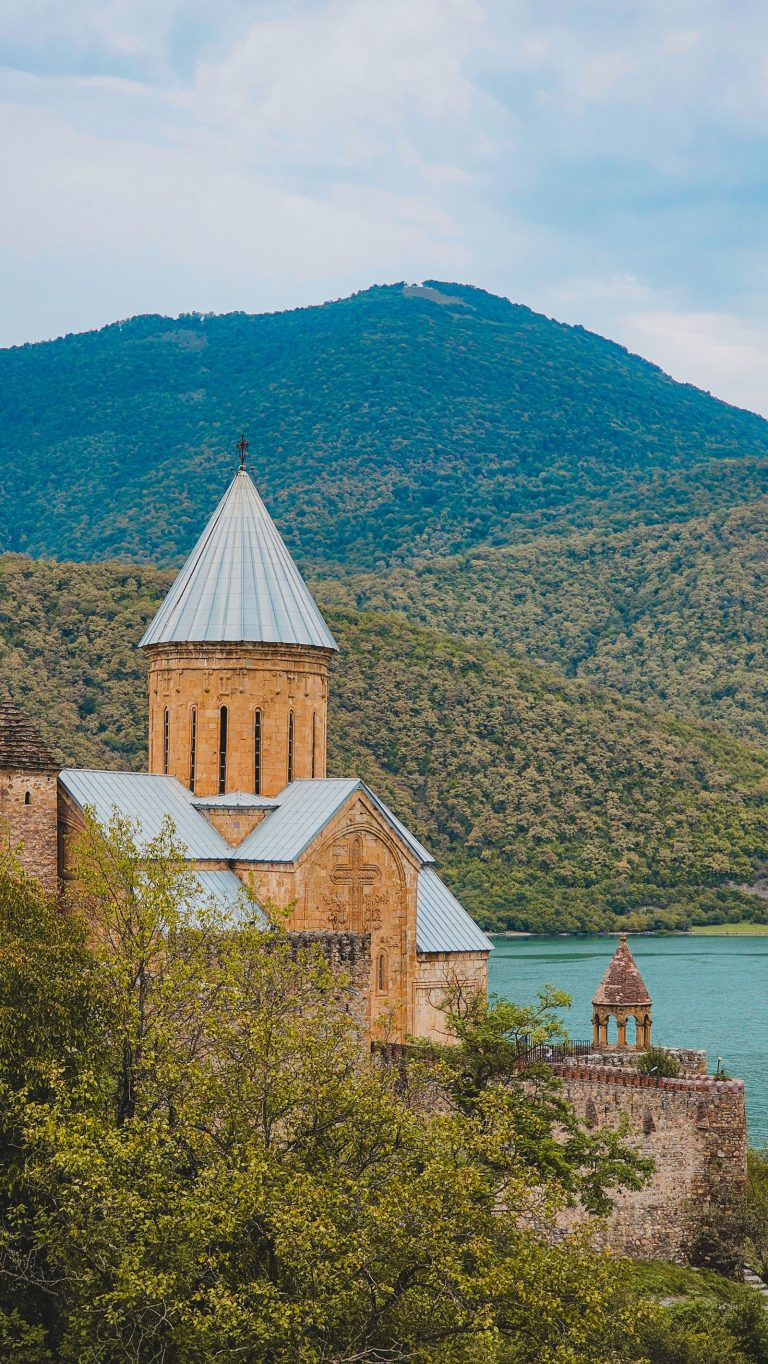
A seventeenth-century fortified church complex above a turquoise reservoir, and the obvious stop on the drive back.
A hiking season, a ski season, and not much else by design.
When Juta, Truso and the high trails are clear of snow and the guesthouses are all open.
Georgia's main resort, with freeriding and heliskiing, half an hour back down the highway.
The only road closes for snow and avalanche risk, sometimes for days. Check before travelling.
A local religious festival at the church above the town.
The best chance of seeing Kazbek, which spends much of its time in cloud.
June to September for hiking. Winter is beautiful and the road is unreliable.
Average highs in the town at 1,750 m — it is considerably colder at the church and colder again higher up. Cloud hides Mount Kazbek for days at a time in any season, so give yourself two nights rather than one.
Pick how you travel. Per person per night, in euros.
Prices are shown in euros for comparison, but you will pay in lari and should bring it in cash. The shoestring doing line is zero because the best walk here is free.
The ones we get asked most.

Compare Kazbegi hostels and guesthouses — live prices, real reviews and free cancellation on most bookings. Then meet the people already there in the app.

 Get the App.
 Get the App.