Ghardaïa old town and market
Markets and first-timersThe biggest ksar, climbing from the arcaded market square to its mosque, with hotels and cafés in the newer town below.

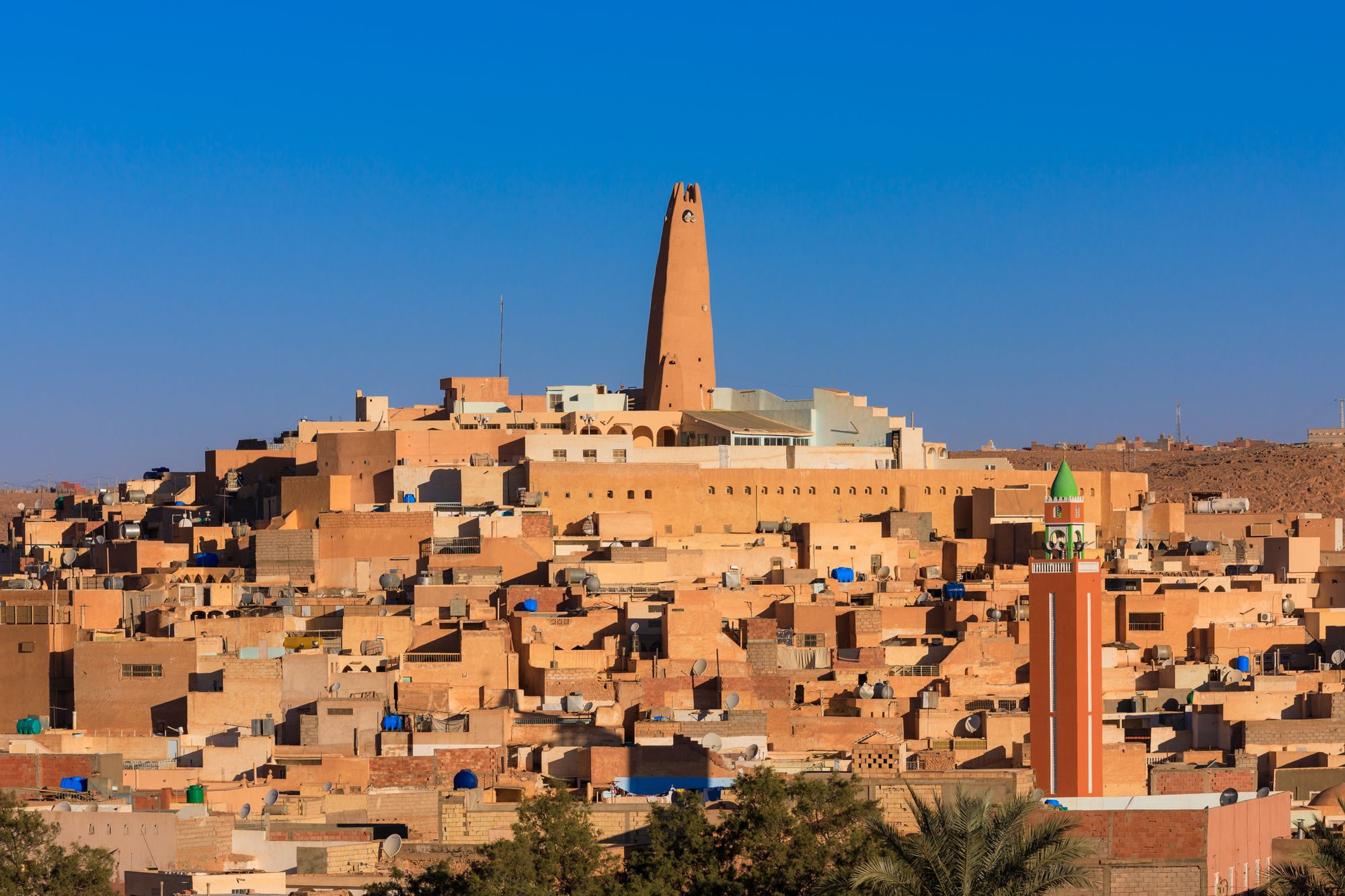
Ghardaïa is the main town of the M'zab Valley, where five walled Mozabite towns, founded between 1012 and 1350, climb small hills above palm groves in the northern Sahara. Come for guided walks through the old towns, the evening auction in Beni Isguen and architecture that influenced Le Corbusier, and stay two or three nights.
Ghardaïa sits in a dry, rocky valley about 600 km south of Algiers, on the northern edge of the Sahara. It is the largest of the five ksour, or fortified towns, of the M'zab: Ghardaïa, Melika, Beni Isguen, Bounoura and El Atteuf. They were built by the Mozabites, Amazigh followers of the Ibadi branch of Islam, between 1012 and 1350, and together they have been a UNESCO World Heritage Site since 1982.
Each town follows the same plan: a mosque on the hilltop, whose minaret doubled as a watchtower, with houses of a standard size built in rings around it, and a palm grove and cemetery outside the walls. UNESCO notes that this architecture influenced 20th-century architects including Le Corbusier and Fernand Pouillon.
The old towns are lived-in, conservative places, not open-air museums. To enter the walled centres you go with a local guide, booked at the tourist offices by the main gates, and you follow their rules: modest dress, no photographs of people, and in Beni Isguen, no smoking at all. Guided entry runs in the morning and late afternoon, so plan your days around it.
The modern town spreads along the valley floor between the ksour, and the towns are close enough that you can walk between Ghardaïa, Melika, Beni Isguen and Bounoura. El Atteuf, the oldest, is a short bus or taxi ride further down the valley.
Two or three nights is about right: one day for Ghardaïa's market and old town and Melika, one for Beni Isguen and its auction, and time for El Atteuf, Bounoura and the palm groves. Avoid summer, when July averages 40°C.
The M'zab is compact, and the five ksour sit within about 7 km of each other along the valley. Most hotels are in Ghardaïa's newer town and around Bounoura; you can't stay inside the walls of Beni Isguen, but there are guesthouses in the palm groves.
The biggest ksar, climbing from the arcaded market square to its mosque, with hotels and cafés in the newer town below.
The best-preserved and strictest ksar. Foreigners can't stay inside the walls, but there are guesthouses nearby.
Hilltop ksar between Ghardaïa and Beni Isguen, with a vast whitewashed cemetery.
Hilltop ksar where the M'zab and Azouil wadis meet. Hotel Belvedere and Gîte Tarist are listed here.
Founded in 1012, furthest down the valley, home of the Sidi Brahim mosque.
Map data from OpenStreetMap contributors.
Start in Ghardaïa itself, founded in 1048, in the morning, when its market is at its liveliest. The arcaded market square sits at the foot of the old town, and above it the houses climb in tiers to the mosque and its tapering, pyramid-shaped minaret. Below the square you can browse on your own; the lanes higher up, with the houses and the mosque, are visited with a guide from the tourist office.
Beni Isguen, a short walk or taxi ride south-east, is the most strictly kept of the five towns and the best preserved. You enter through the eastern gate, Bab Charki, where the guides' office is, and walk inside a rampart more than 1.5 km long up to the Boulila tower at the top of the town, for a view over the palm grove and the valley. A small museum in the old town hall reconstructs the ground floor of a traditional Mozabite house. Come back in the late afternoon for the auction on the market square, Lalla Achou, where auctioneers sell anything from wool clothes to dates.
Melika, on a hill between Ghardaïa and Beni Isguen, is quieter. North of the town is a vast cemetery of whitewashed graves around the tomb of Sidi Aïssa, with a good view back over Ghardaïa. One 2025 traveller found no guide was needed here, unlike in the other towns.
Bounoura stands on a rocky hill where the M'zab wadi meets the Oued Azouil, with an old Grand Mosque, and El Atteuf, founded in 1012, is the oldest of the five. Its mosque of Sidi Brahim is often said to have inspired Le Corbusier's chapel at Ronchamp.
For a modern counterpoint, visit Tafilelt, an eco-ksar of 1,050 homes built from 1997 on the hill south of Beni Isguen in the traditional style, with views over the valley. Finally, ask your guide about the palm groves outside the walls, where wells and floodwater channels built over centuries still water the gardens.
Much of the M'zab costs little or nothing. Ghardaïa's market square and the streets below the old town are free to wander, and the morning market is the best people-watching in town.
The guided walks are cheap. Posted guide prices in 2025 were 250 to 500 dinars per person, depending on the size of your group, which is about €1 to €2 at informal rates. A good guide is the best value in the valley.
Melika's hilltop cemetery is open to walk and has one of the best views over Ghardaïa. Walk between the towns, too: Ghardaïa, Melika, Beni Isguen and Bounoura are all within walking distance of each other.
The Beni Isguen auction costs nothing to watch. Arrive at the market square around 5pm and stand back while the auctioneers work.
Ask your guide about a walk in the palm groves at the end of the day, when the light softens and the heat drops.
Food in Ghardaïa is simple and filling. Couscous is the staple, often with vegetables such as pumpkin and carrots, and chakhchoukha, torn flatbread in a spicy tomato stew, is served on special occasions. Mhajeb, square flatbreads stuffed with spicy tomatoes and onions, make a cheap snack.
Dates are everywhere. The valley grows deglet nour, eaten fresh, in stews and in sweets such as makroud, semolina pastry filled with date paste. The market sells them alongside almonds and spices.
For a sit-down meal, one 2025 traveller recommends El Djawhara, on the road towards Beni Isguen, and Restaurant Khaima Hamma nearby, which has a traditional Berber interior. A guide updated in October 2026 puts café meals at around US$3 to $6.
Mint tea is the drink of the M'zab, and coffee is strong. Don't expect alcohol: travellers report it isn't sold in town. During Ramadan, restaurants in the old town stay closed until sunset.
Ghardaïa has no nightlife in the usual sense. The evening starts with the auction in Beni Isguen, from around 5pm, then moves to cafés in the modern town for mint tea and coffee.
The old towns are private at night. Guided entry ends at 6pm, and signs in the ksour have asked visitors to leave before sunset, so plan your walks for the morning and late afternoon.
The town is quiet after about 10pm. Taxis are scarce after dark across Algeria, so agree a lift back with your hotel or driver in advance.
Ramadan is the exception: after sunset, cafés and pastry shops stay open late. Winter nights in the desert are cold, around 5°C in January, so bring a warm layer.
The easiest way to Ghardaïa is to fly. Air Algérie flies from Algiers to Noumérat – Moufdi Zakaria Airport in about 1 hour 20 minutes, with up to 12 direct flights a week, and round trips usually cost around €40 to €55. It also flies to Ghardaïa from Oran and Constantine. The airport is about 16 km south-east of town; one traveller paid 2,000 dinars for the 30-minute taxi ride in 2025. In 2025, one traveller was met by police at the airport, asked about their plans and escorted into town, so have your hotel address and contacts ready.
By road, buses from Algiers take about 10 hours, often overnight. Buses and shared taxis also run to Laghouat, about 200 km north, and Ouargla, about 190 km east. There is no railway.
In the valley, Ghardaïa, Melika, Beni Isguen and Bounoura are close enough to walk between. For El Atteuf, local bus 30 takes about 45 minutes from Ghardaïa, or take a taxi. Taxis are cheap, but agree the fare before you get in.
Algeria has a very high road accident rate, so avoid long road journeys at night.
Ghardaïa is cheap for food, guides and local transport, but rooms cost more than you might expect. There are no hostels. Listing sites show hotels such as El Djanoub at around US$70 a night and Gîte Tarist in Bounoura at around US$57; in Algeria generally, decent rooms start at about €30, and travellers recommend paying cash in dinars on arrival, which works out much cheaper at informal rates.
Guided walks through the old towns cost 250 to 500 dinars per person at the posted 2025 rates. Taxis around the valley are cheap, and the 30-minute airport taxi cost one traveller 2,000 dinars.
Air Algérie round trips from Algiers usually cost around €40 to €55, and the bus is cheaper but takes about 10 hours.
Bring euros in cash. The official rate is about 151 dinars to €1, but a 2025 traveller found up to 252 dinars to the euro on the informal market, in line with other 2026 reports. Cards are rarely accepted in Ghardaïa.
Ghardaïa is outside the areas where the UK advises against travel, which are near Algeria's borders with Libya, Mali, Niger, Mauritania and parts of the Tunisian border. But the UK also says terrorist attacks could happen anywhere, with a higher risk in the Sahara, and that the kidnap risk is concentrated on the southern border. Check the latest FCDO advice and your insurance before you go.
Expect a visible security presence. One 2025 traveller was met by police at the airport and escorted into town, and checkpoints on the roads are routine. Carry your passport, be patient and follow instructions.
The valley has a history of communal tension: between 2013 and 2015, clashes between Mozabite and Arab residents killed more than 20 people. Stay away from any gatherings or demonstrations.
The local rules matter. Dress modestly, covering shoulders and knees. Don't photograph people, and never photograph women, who wear white wraps in the ksour. Smoking is banned in Beni Isguen, even in the street. Follow your guide's lead in the old towns.
Summer heat is a real risk, with July averaging 40°C. Carry water, cover up and rest at midday.
The four other M'zab towns are the obvious trips, all within 7 km and easy to combine. Further out, Berriane is the M'zab's northern outpost, and El Menia is a long ride south.
The strictest and best-preserved ksar, with the Boulila tower, a small museum and the late-afternoon auction. Guided visits only.
Quiet hilltop ksar with a huge whitewashed cemetery and the tomb of Sidi Aïssa.
Hilltop ksar at the meeting of two wadis, with an old Grand Mosque and views across the valley.
The oldest of the five towns, founded in 1012, and home of the Sidi Brahim mosque.
Eco-ksar of 1,050 homes built from 1997 in the traditional style, on the hill south of Beni Isguen.
The M'zab's northern town, part of the valley's community since the 17th century, known for carpets and its palm grove.
Oasis town further south with an old ksar and the grave of Charles de Foucauld.
Ghardaïa's own big event is the national carpet festival in spring. Ramadan and the Eids move about 11 days earlier each year.
Amazigh New Year, a public holiday, marked with family feasts.
Daytime fasting; old-town restaurants close until sunset, and evenings are busy.
The end of Ramadan, with family visits and many shops closed.
Craft stalls, weaving workshops, a parade of carpet-decked floats and fantasia shows. Check this year's dates.
Ghardaïa is a Saharan town: very hot from June to September, with July averaging 40°C, and pleasant from October to April. March, April, October and November are the most comfortable months, while winter days are mild and nights cold.
Highs are weather2travel's average maximum daytime temperatures for Ghardaïa, rounded to the nearest degree. Crowd levels are our own rough guide.
Pick a style and a number of nights for a rough total, per person, in euros.
Estimates at informal exchange rates (around 250 dinars to €1). With no hostels in Ghardaïa, beds are based on hotel and guesthouse prices; doing includes guided walks through the old towns. Flights are extra.
Prices, rules and timetables change. Check before you travel.

Compare Algeria hostels: live prices, real reviews and free cancellation on most bookings. Then meet the people already there in the app.

 Get the App.

 Get the App.