
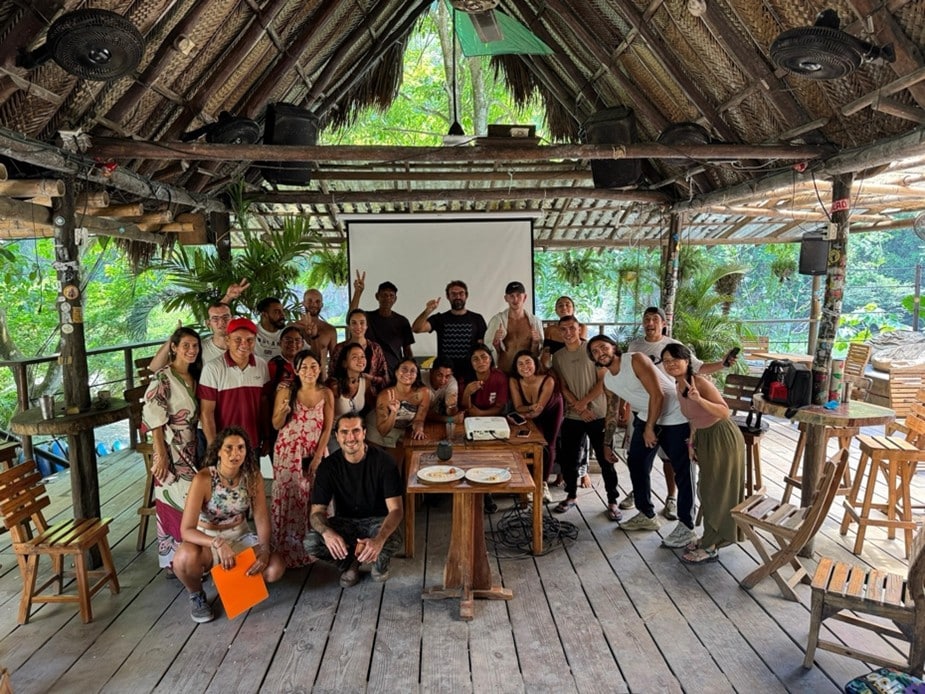


(L: Entrance to El Rio Hostel. R: Boat trip with our guide Gabriel and dog Suki)
A year ago, you met Amy Phung, winner of Hostelworld’s yearly staff travel competition, who spent several weeks travelling across Colombia – hopping from hostel to hostel, and discovering a country that surprised her at every turn.
Almost a year on, Amy reflects on her time volunteering with El Rio Hostel and Foundation, and how it changed the way she travels.
El Rio – A hostel and an educational foundation
(With the staff of El Rio Foundation during a training workshop)
On Colombia’s North Caribbean coast, on the edge of Tayrona National Park, El Rio Hostel and Foundation brings together a team of 25 staff and a rotating group of volunteers, supporting 11 communities and 600 children in the surrounding area.
Ben, co-owner and one of the founders, explained the background of the project: “The hostel and Foundation are a joint initiative where some of the profits from events held in the hostel are funnelled directly into the Foundation.”
This includes Foundation Wednesdays, which have been running for seven years. As Ben explains, “Every Wednesday, a purchase of rum and Coke at the hostel bar funds 45 minutes of education. With an average of 200 sold per week, the benefits of staying at El Rio Hostel quickly add up.”
El Rio parties are well-known in the Colombian backpacker community, with a portion of proceeds supporting the Foundation’s educational work.
When having fun is what matters
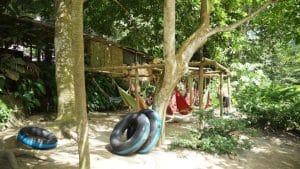
(Tubing on the Buritaca River is a popular activity, or there are plenty of hammocks to unwind)
Felix, Director of Impact and Fundraising, explained that a central tenet of the Foundation’s work is simple: having fun.
Located in a post-conflict zone where decades of violence and narcotics trafficking have impacted local infrastructure, the region is often overlooked when it comes to social development.
That’s where the Foundation comes in.
Lessons are centred around formal learning and games, which provide a sense of hope and joy and enable local children to imagine a pathway to higher education and new opportunities. Volunteers also provide space for cultural exchange, giving children the chance to practise English and connect with people from around the world.
This focus on fun extends to the team. Training sessions are filled with games, talks, workshops, and monthly discussions aligning the UN Global Objectives with organised lesson plans – all designed to strengthen both skills and community.
Leading initiatives, through lived experiences
The long-term success of the Foundation is clear – it invests in its people.
Ben shared how volunteer-led English lessons support the development of hostel staff who come from local villages rather than big cities.
As he explains, “ensuring that community-building initiatives are led by those who have a lived experience of dispossession and conflict means that the work is tailored towards the needs of those who rely on it.”
English lessons at a local school
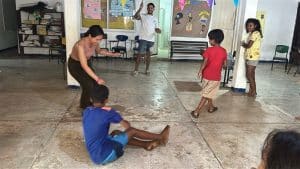
(Playing a word game with the kids during the English lesson)
After a few days of workshops and getting to know the team, we took a moto-taxi to a local school for English lessons.
It was near the end of term, when attendance tends to drop off. However, the news of visitors spread quickly, and we found ourselves surrounded by curious kids who quizzed us about England and snow.
Jhon, one of the Foundation staff members, explained that the medium-sized room we were teaching in normally holds three lessons simultaneously during regular school time – a challenge for kids who may struggle to stay focused.
Next day: sports class
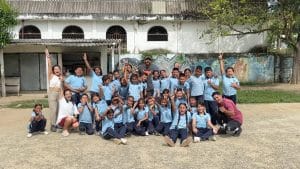
The following day, we led a sports class – an important resource for schools that don’t have their own physical education programme. Through team games and dance lessons, the children welcomed the volunteers enthusiastically.
One small child, around 8 years old, immediately approached with a big smile and hugged us. Despite the language barrier, we bonded over our shared hairstyle of pigtails.
Volunteering with the children forced me to be fully present in the moment.
In a world where distraction is ever-present from phones and the daily worries of life, connecting with the children was a reminder that community is the keystone to a sense of belonging and growth.
Left my heart in El Rio
Writer and activist adrienne maree brown wrote, “Small is good, and small is all”, describing how incremental and hyper-local positive actions can lead to meaningful change.
That philosophy is reflected in the work of the Foundation, which focuses on immediate community needs – sharing resources and respecting the histories and cultures of those they work with.
It also feels like the perfect description for the children we spent time with – sweet and sometimes cheeky.
Left my heart in El Rio, might be the name of a hit if I were talented enough to be a songwriter, but it encompasses how I felt leaving. It’s not an understatement to say that the experience was profoundly formative for me.
I have rarely felt such a strong sense of home on my travels to the degree that I did in Colombia.
One year on, and how to get involved
The work at El Rio continues year-round, supported by ongoing learning programmes, fundraising initiatives, and the contributions of staff, volunteers, and travellers – all critical to foster and support the children’s love of learning and development.
👉 support the foundation if you can: The El Rio Foundation – Based out of the award winning Rio Hostel, Buritaca
👉 book your stay at the hostel, and get involved in the community work: Rio Hostel Buritaca, Buritaca – Online Hostel Bookings, Ratings and Reviews
Just be warned, you’ll find it hard to leave.

 Get the App.
Comments