

Is Sri Lanka good for surfing? Yes, all year round, as long as you pick the right coast. This surfing in Sri Lanka guide starts with that simple rule, because the island has two coasts with two seasons.
According to The Surf Atlas, the south and west coast works from about November to April, and the east coast around Arugam Bay takes over from about May to September. Dorm beds start at under €4 a night, and every surf town on both coasts has hostels within walking distance of the break.
Below you’ll find the seasons, the best spots for your level, what a trip costs, the entry rules and where to stay. You’ll also find first-hand tips from Barbara, our Social Media Manager, who went to Sri Lanka in February 2026 and took surf lessons in Weligama. If you’re planning the rest of the island too, our Sri Lanka backpacking guide covers the full route.
When is the best time to surf in Sri Lanka?
The best time to surf in Sri Lanka depends on the coast. The south and west coast is on from late October to early May, and Arugam Bay on the east coast is on from May to September. Each coast is sheltered when the other gets the monsoon, which is why there’s surf somewhere on the island all year.
Here’s how the year breaks down, month by month, based on The Surf Atlas and Lanka Websites:
- November to March is the south coast’s main season, with clean mornings and 2 to 5ft waves around Weligama, Mirissa and Ahangama. Arugam Bay is flat because of the northeast monsoon. This is also when the southern line-ups are at their busiest.
- In April the south keeps working but starts to wind down. Late April is a shoulder period when both coasts can have waves, depending on the weather.
- In May the south fades in the first week or two and Arugam Bay’s season begins, often with smaller, friendlier waves.
- June to August is peak season in Arugam Bay, with the most consistent and powerful swell, and the busiest line-ups at the main breaks. The south coast is wet and stormy under the southwest monsoon.
- In September Arugam Bay keeps going, with smaller waves early in the month.
- In October the east winds down and the south comes back from late October, another shoulder period.
So if you’re thinking about surfing in Sri Lanka in July, head east: that’s Arugam Bay’s best stretch, and the south won’t give you much. Coming in December or February means the reverse. Barbara, our Social Media Manager, who was in Sri Lanka in February 2026, gives the same split: there’s surf all year round, but the east coast is generally better from May to September and the south coast from October to April.
If you have less than two weeks, commit to one coast. The two coasts are on opposite sides of the island, and outside the shoulder months only one side will be working anyway. If you’ve got longer and want to see more of the island between surf sessions, our two weeks in Sri Lanka on a hostel budget route is a good starting point.
Where should beginners surf in Sri Lanka?
Learn in Weligama between November and April, or at Baby Point near Arugam Bay between May and September. Both have small, forgiving waves over sand and plenty of people to teach you.
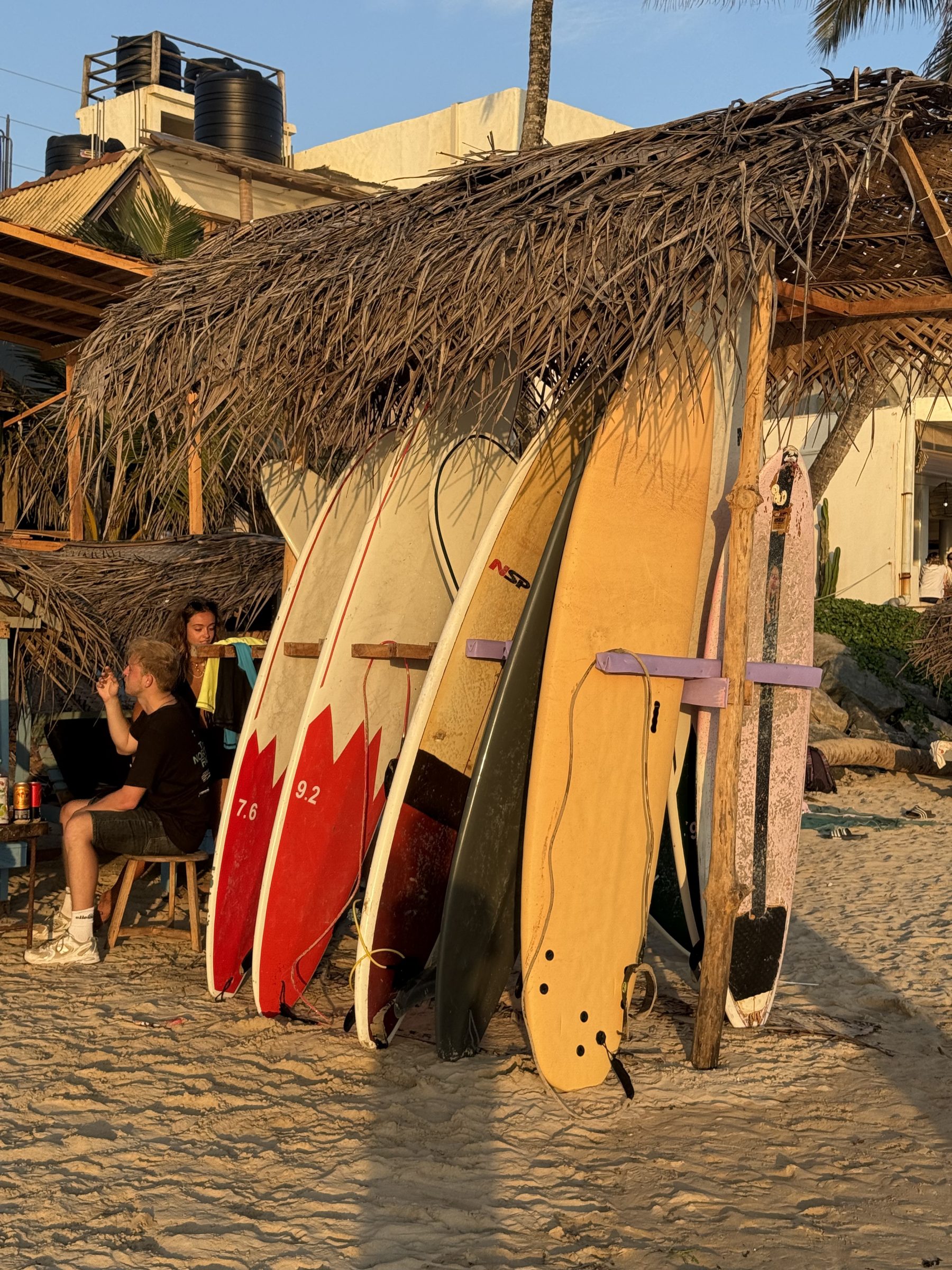
- November to April: Weligama. The Surf Atlas calls it a mellow beach break for learners and longboarders, with dozens of board rental stands and surf schools along the sand. Hiriketiya, further east, is a second option, and the same guide says its small bay has decent waves for beginners.
- May to September: Baby Point, Arugam Bay. It produces 2 to 4ft waves on a sandy bottom, according to Lanka Websites. Once you’re standing up comfortably, move on to Elephant Rock, where waves run 2 to 6ft over sand with some rocks.
Barbara, our Social Media Manager, learned in Weligama in February 2026. She booked a private lesson for around €20 and found the one-to-one coaching helped her progress quickly. Her advice for anyone getting on a board for the first time:
Weligama is where she’d send beginners too, for its friendly waves, though she warns it gets crowded in peak season:
Book a lesson for your first day or two before you rent a board on your own. An instructor will pick the right part of the beach, show you where the line-up sits and keep you out of other surfers’ way. On the days you’re not in the water, our list of things to do in Sri Lanka has plenty more.
Which south coast surf towns suit intermediate surfers?
Once you can paddle into green waves and turn, base yourself between Midigama and Ahangama, where the south coast’s reef and point breaks sit close together. The whole stretch runs east along one coastal road, from Hikkaduwa past Galle to Hiriketiya, and The Surf Atlas maps 21 south coast beaches for surfing. That means you can stay in one town and hop to another break by tuk-tuk or scooter when your local spot is too small or too crowded. Most of these waves break over reef rather than sand, so they reward surfers who already have the basics and punish those who don’t.
Here’s how the towns compare, from west to east:
- Hikkaduwa is the first of these towns on the coast road south from Colombo, with a mix of reef and beach breaks, so it’s a handy first or last stop if you’re flying in or out.
- Ahangama and Midigama are the intermediate heartland, with reef and point breaks such as Kabalana, Lazy Left, Lazy Right and Ram’s Right, all described in The Surf Atlas guide to Midigama. Lazy Left is a mellow reef left that many surfers try first, while Ram’s is an expert wave over coral, according to Ceylon Sliders. Expect busier line-ups at the best-known names, especially mid-morning.
- Hiriketiya is a horseshoe-shaped bay with a beach break on one side and a reef on the other, so mixed-level groups can surf the same bay.
Check the tide before you paddle out on a reef. Several of these breaks are reefs, and some, like Ram’s, break over shallow coral. Wear reef booties at low tide, ask at your hostel or the nearest board rental which tide suits each break, and pack antiseptic. For the rest of the region, from Galle Fort to the hill country, browse our Sri Lanka travel guides.
What is surfing in Arugam Bay like?
Arugam Bay surf is at its best from May to September, when long right-hand points peel along the east coast and the town fills up with surfers. The headline wave is Main Point, which is good enough to host the Surfing Federation of Sri Lanka’s national championship: the 2026 edition ran there from 10 to 12 September, with competitors from more than 12 countries, The Morning reported.
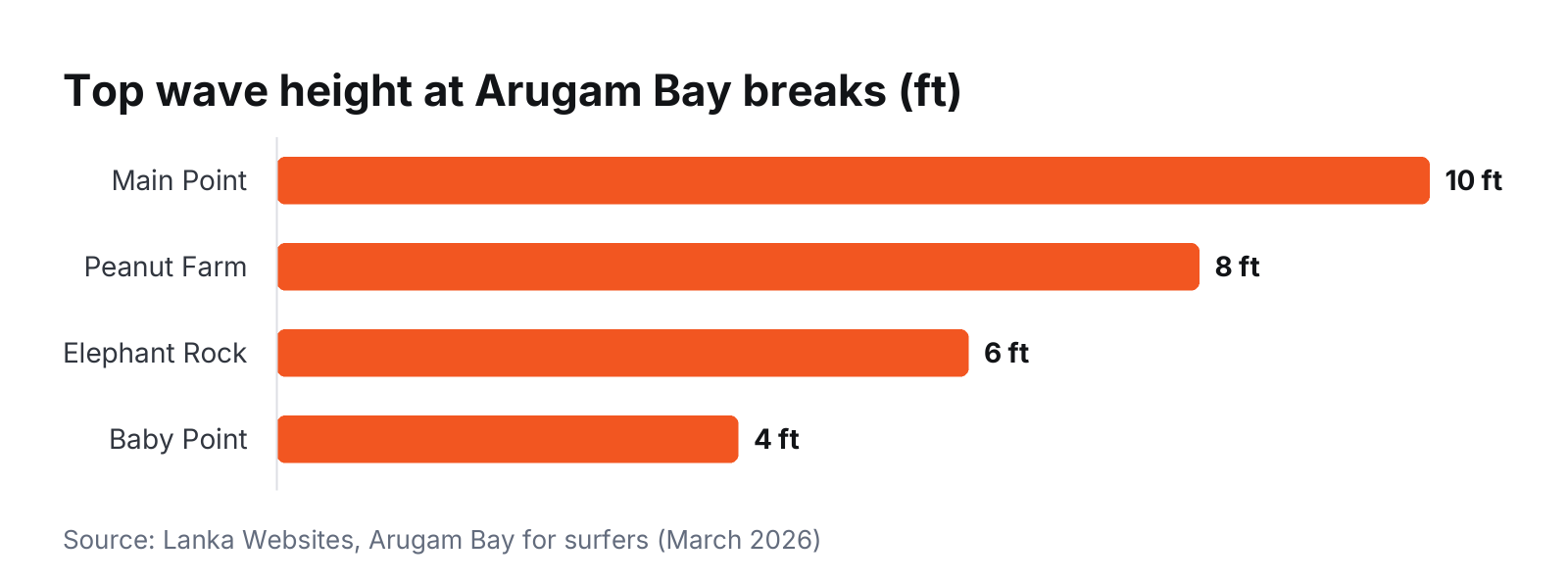
That quality brings crowds. Lanka Websites rates Main Point as an advanced wave of 4 to 10ft over mixed reef and sand, with heavy traffic in the line-up in peak season. If you’re not confident in a packed line-up, spread out to the other breaks, most of them a tuk-tuk ride north or south of town:
- Main Point is for advanced surfers, with long rides and the busiest line-up.
- Peanut Farm, south of town, is an intermediate wave of 3 to 8ft over sand and rock.
- Elephant Rock suits beginners moving up to intermediate, with 2 to 6ft waves and plenty of surf schools.
- Baby Point is the beginner spot, 2 to 4ft over sand.
- Whisky Point, further north, is another option when the bay breaks are crowded.
Time it right and you’ll have more room. The same guide suggests May or early September for smaller, more manageable waves, and early morning sessions are quieter than mid-morning. June to August is peak season, with the strongest swell and the most people.
How much does a surf trip to Sri Lanka cost?
Prices checked 5 November 2026. Beds and lessons change with the season and your dates, so treat these as a guide and check again before you book.
A dorm bed in a Sri Lankan surf town costs about €4 to €12 a night, and a two-hour beginner group lesson costs around €21 to €27. Lessons, not beds, are where most of your surf budget goes.
Beds first. On Hostelworld’s Arugam Bay listings, dorms start at €4.15 a night at The Long Hostel, and most surf hostels in town sit between €7 and €12. Weligama is a touch cheaper at the bottom end: the lowest dorm we found was €3.31 at One More Day Hostel, with most others between €4.50 and €11. A few co-living places and surf camps charge far more, so sort by price if you’re on a tight budget.
| Dorm, Weligama (from) | €3.31 |
| Dorm, Arugam Bay (from) | €4.15 |
| Group lesson (app) | €21 |
| Group lesson | €27 |
| Private lesson (app) | €43 |
| Private lesson | €53 |
Surf and Stay Arugambay lists a two-hour beginner group lesson at $30 (about €27), or $24 (about €21) if you book through the Hostelworld app. A two-hour private one-to-one lesson is $60 (about €53), or $48 (about €43) through the app. We converted the dollar prices at the European Central Bank’s reference rate on 5 November 2026 ($1.1224 to €1).
Board hire is harder to pin down. We couldn’t find a current, published rate we trust, and prices vary by town and by stand. Agree a daily or weekly rate before you paddle out, and ask whether it covers a leash and fin repairs.
Book your lessons in the app before you arrive. On the Surf and Stay prices above, that saves 20% on every lesson, which adds up over a week of daily sessions. If Sri Lanka is one stop on a longer trip, our guide to backpacking Southeast Asia covers the next leg.
Do you need a visa to surf in Sri Lanka?
Yes, every foreign visitor needs an Electronic Travel Authorization (ETA) before arriving, but for a lot of travellers it now costs nothing. According to Sri Lanka’s Department of Immigration and Emigration, nationals of 40 countries can get a free tourist ETA for 30 days from 25 May 2026, with two entries allowed inside that 30-day window.
- The free ETA covers the UK, the US, Australia, Canada, Germany, France, Spain, Italy and the Netherlands, among others. Read the full list before you apply: Ireland isn’t on it.
- If you want to stay longer than 30 days, for example to surf the end of the south coast season and then head to Arugam Bay, you’ll need a visa extension, which comes with the applicable visa fee.
- Everyone else still applies for an ETA under the standard rules and pays the standard fee, so check the current price on eta.gov.lk.
Apply only on the official site, eta.gov.lk. Agency sites can look very similar, so check the address before you pay. Entry rules can change at short notice, so look again in the week before you fly, especially if Sri Lanka is one stop on a longer route through other countries in Asia.
What are the surf etiquette rules in Sri Lanka?
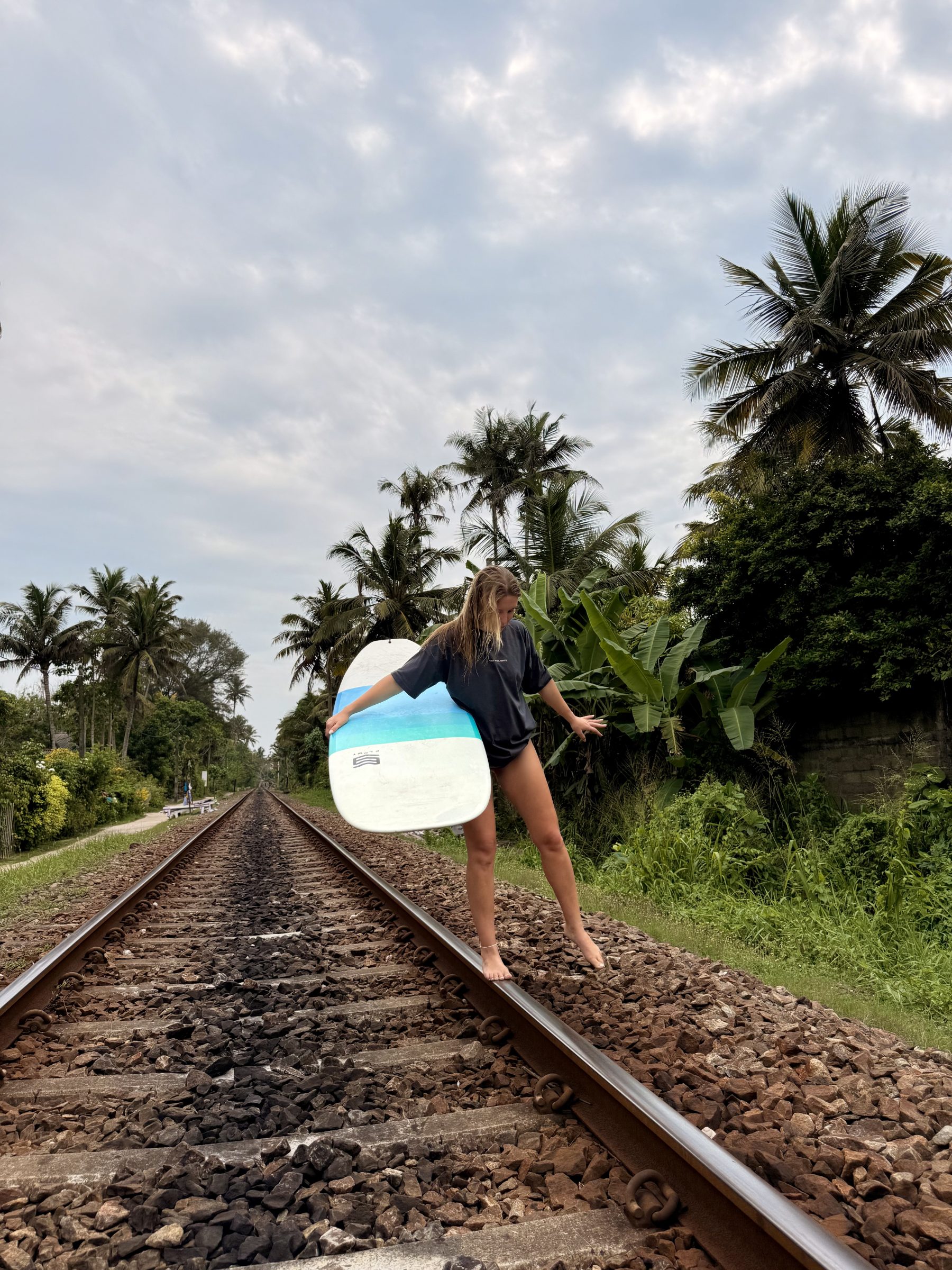
The rules in Sri Lankan line-ups are the same as anywhere else, and locals expect you to know them. Most trouble in the water starts when a visitor drops in or paddles straight to the peak.
Barbara, our Social Media Manager, surfed the south coast in February 2026. Her warning on line-up etiquette:
So book your lessons with a Sri Lankan surf school or instructor, then follow these rules once you’re in the water:
- The surfer closest to the peak has the wave. If someone is already up and riding, or is closer to where the wave is breaking, pull back.
- Don’t drop in. Taking off in front of someone already riding is the fastest way to get shouted at.
- Don’t snake. Paddling round someone to sit inside them at the peak counts as stealing their turn. Wait your turn in the rotation.
- Beginners stay on the inside. Learn in the white water at Weligama or Baby Point, and keep away from point breaks such as Main Point in Arugam Bay until you can paddle and turn with confidence.
- Hold onto your board. Never throw it when a wave comes at you, and wear a leash. Stick to a soft-top on crowded beach breaks, where a loose hard board can hurt someone.
- Paddle wide of the take-off zone. Go back out through the channel or the white water, not across the path of someone riding.
- Respect the locals. Smile, say hello, don’t arrive in a big group at a small peak, and give way to local surfers at their home break.
Out of the water, cover up when you leave the beach: put on a T-shirt and shorts or a sarong before you walk into town, a shop or a café. Dress rules are stricter at temples, so read the UK government’s Sri Lanka travel advice on local laws and customs before you visit one.
Look after yourself on the reef, too. Most of the intermediate breaks on the south coast and around Arugam Bay break over reef, so check the tide, wear booties if it’s shallow and clean any cut straight away. The sun near the equator burns fast even on cloudy mornings: wear a rash vest and reapply water-resistant sunscreen between sessions. The same respect for local customs goes for the rest of your trip; our tips on how to explore a new city are a good place to start.
Where should you stay for surfing in Sri Lanka?
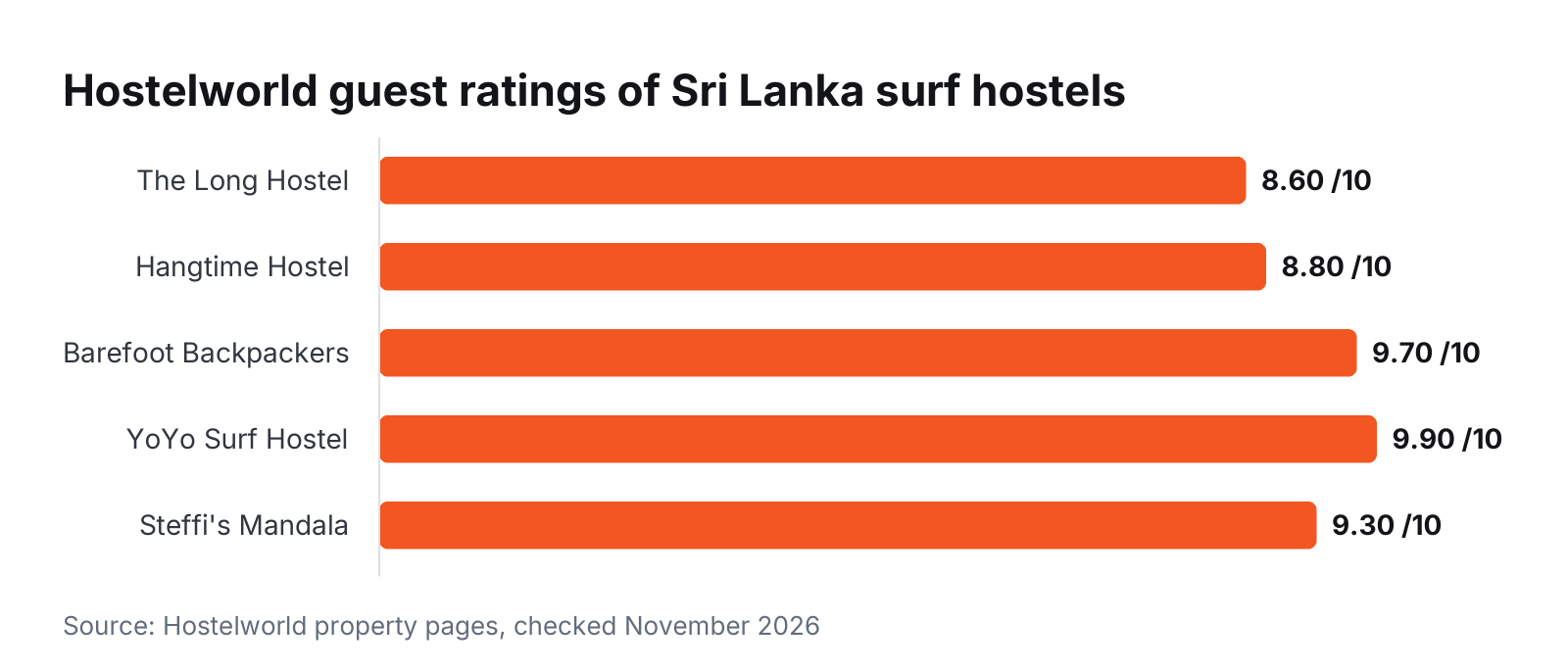
Stay in the town beside the break you’ll surf most, so you can paddle out at dawn before the wind picks up. These surf-friendly hostels are listed on Hostelworld, with guest ratings checked in November 2026.
The Long Hostel, Arugam Bay
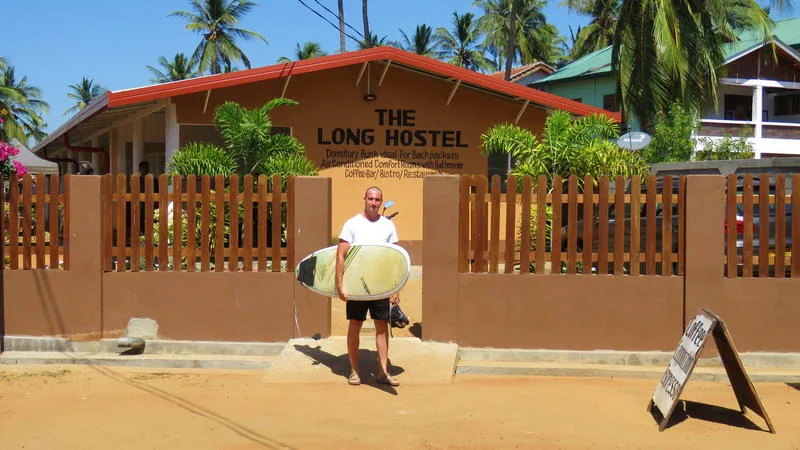
Your east coast base: The Long Hostel is on Panama Road, under a kilometre from the centre, and rated 8.6 by guests on its Hostelworld listing.
Hangtime Hostel, Weligama
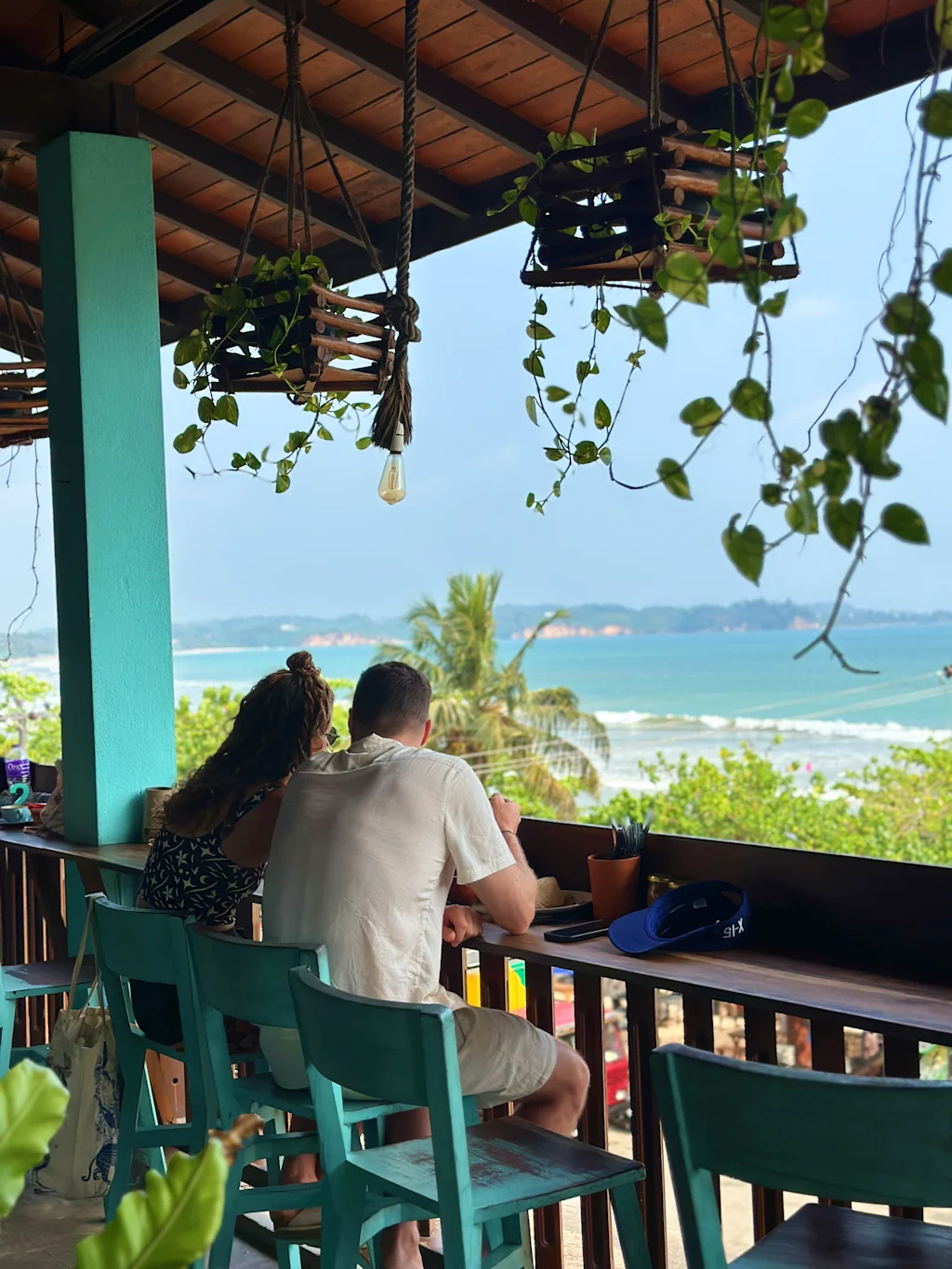
Good for beginners at Weligama’s gentle beach break, Hangtime Hostel is rated 8.8 on Hostelworld, and its listing includes a coworking space for remote workers.
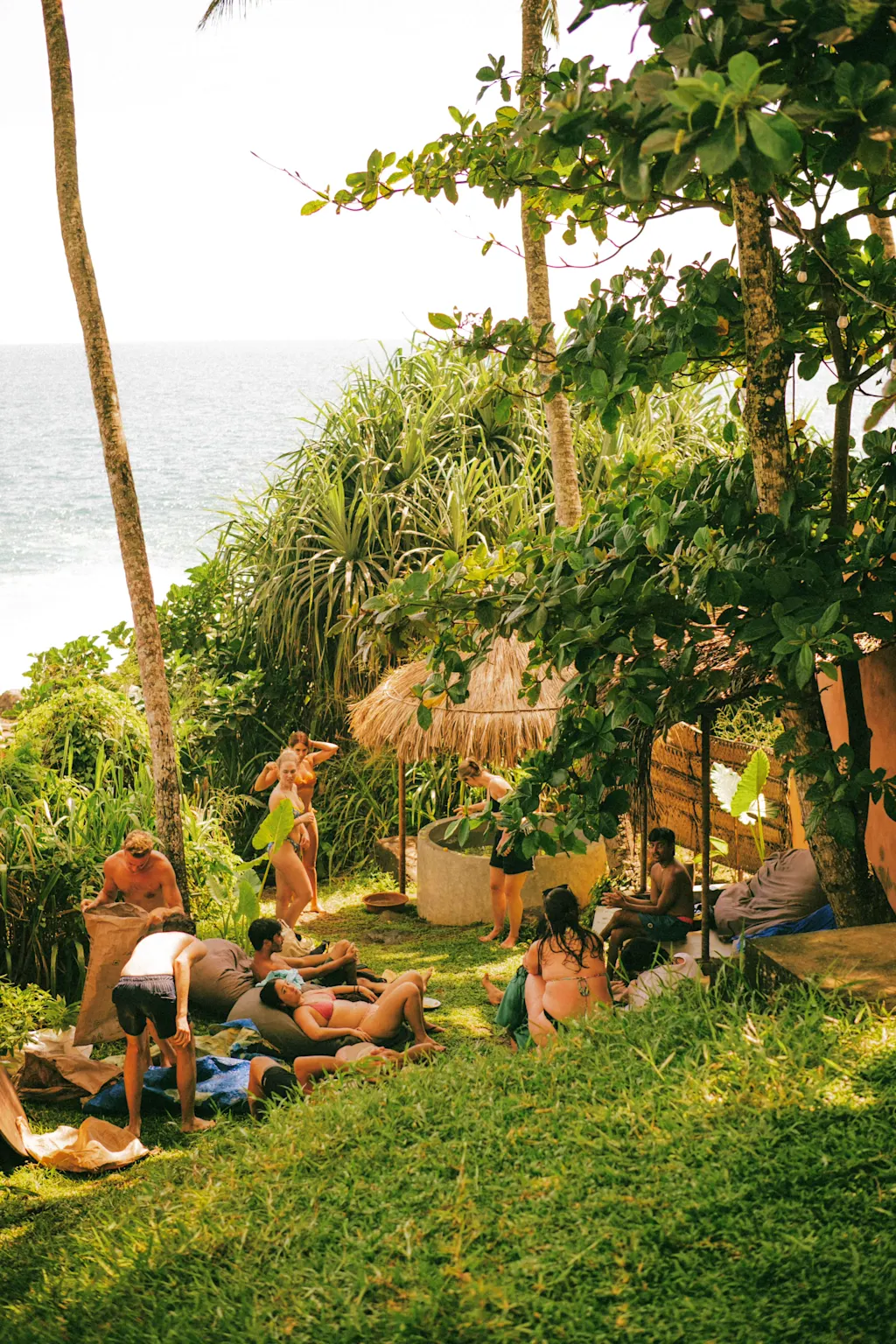
Barefoot Backpackers Hostel, Hiriketiya
Rated 9.7 on Hostelworld, it’s a 7-minute walk from Hiriketiya beach according to its listing, close enough to check the bay before breakfast.
Finding other surfers
Once you’ve booked, the free Hostelworld app lets you join Linkups such as surf lessons from 14 days before check-in, and City Chats put you in touch with travellers at any hostel in town. If you haven’t booked, Social Pass opens those features anyway. For a longer view of life on the road, read about how backpacking has changed.
Conclusion: which coast should you surf?
Let the month you fly pick the coast. From November to April, go south. From May to September, go east to Arugam Bay. That one rule settles most of the planning for surfing in Sri Lanka.
On the south coast, learn in Weligama, where the beach break is gentle and the surf schools line the sand. Once you can turn and duck dive, move along to Ahangama or Midigama for a bit more challenge and smaller crowds.
In the east, Arugam Bay is the base for the season’s right-hand points, and you can still learn on the easier breaks nearby before trying the main ones.
Then sort the practical bits. Apply for your ETA on the official site well before you fly, and book a bed within walking distance of the break you’ll surf most, so the dawn session is a short walk away.

 Get the App.
Comments