Alger-Centre
Budget stays and transportThe French-era downtown around the Grande Poste, with arcaded streets, cafés, the cheapest hotels and metro stations.

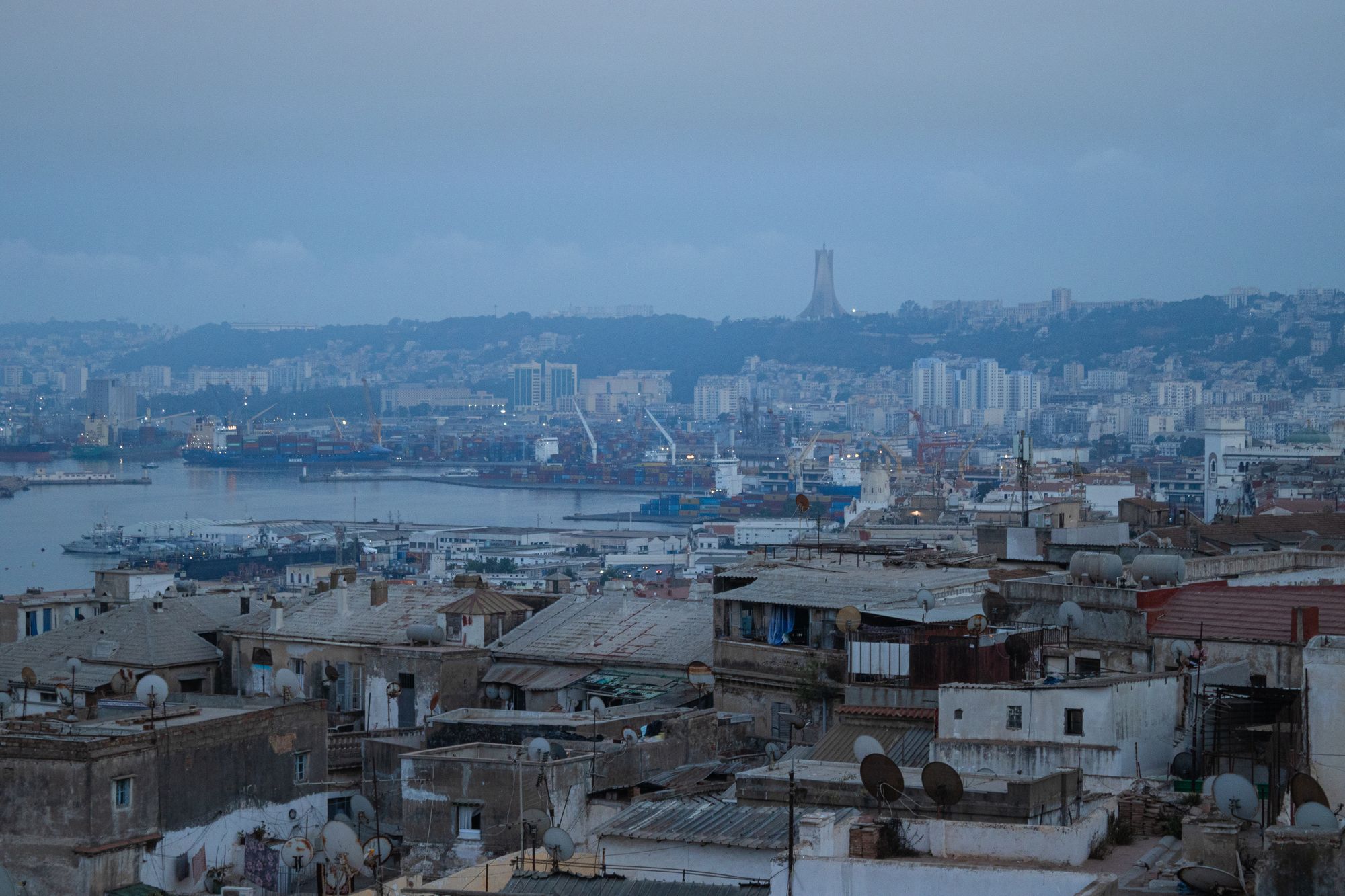
Algiers climbs from a wide bay in tiers of white buildings: the UNESCO-listed Casbah of Ottoman palaces and steep lanes, a French-built downtown of arcades and Neo-Moorish landmarks, and hilltop monuments with views over the Mediterranean. It is Algeria's capital and its main gateway. Give it three nights, and add a day for the Roman ruins of Tipasa.
Algiers is Algeria's capital and largest city, with a metro area of over four million people. It is built on hills that rise steeply from the Bay of Algiers, and its whitewashed buildings gave it the French nickname Alger la Blanche, Algiers the White. Most visitors arrive here, at Houari Boumediene Airport about 20 km from the centre, or by ferry from Marseille or Spain.
The city has three layers that are easy to tell apart. At the top is the Casbah, the old Ottoman town, a UNESCO World Heritage site since 1992, where narrow lanes and stairways tumble down past palaces, mosques and family houses towards Place des Martyrs and the sea. Below and south of it is the French-era centre, Alger-Centre, with arcaded boulevards, the Neo-Moorish Grande Poste and most of the cheaper hotels. Further out, on the heights and along the bay, are the monuments of independent Algeria: the Martyrs' Memorial above the Jardin d'Essai botanical garden, and the vast Djamaa el Djazaïr mosque, whose 265 m minaret is the tallest in the world.
West of the Casbah, the basilica of Notre-Dame d'Afrique stands on a 124 m cliff above Bab El Oued, a working-class seafront district. Getting between all of these is cheap and fairly easy: a metro line runs from Place des Martyrs through the centre, a tram runs east, and short cable cars climb some of the steepest slopes.
Algiers is not a backpacker city. There are no hostels on Hostelworld here, hotels are the main cost, and you will meet few other travellers. Algerian authorities take visitors' safety seriously, and you may notice a strong police presence. The UK advises using a good local guide for the Casbah.
Three nights is about right: one day for the Casbah and the centre, one for the Martyrs' Memorial, the Jardin d'Essai and the museums, and one for a day trip west to Tipasa.
Most travellers stay in Alger-Centre, which has the cheapest hotels and the best transport links. The Casbah and Bab El Oued are close to the old town and the sea, Hamma suits museum days, and Hydra, up on the heights, is the smart embassy district.
The French-era downtown around the Grande Poste, with arcaded streets, cafés, the cheapest hotels and metro stations.
The UNESCO-listed Ottoman old town on the hill above Place des Martyrs. Lanes are steep and confusing; explore with a guide.
Working-class seafront district north-west of the Casbah, close to the cable cars up to Notre-Dame d'Afrique.
Home to the Jardin d'Essai and the Fine Arts Museum, with the metro and the cable car up to the Martyrs' Memorial.
District on the heights of Algiers where most foreign embassies are. Away from the old town and a taxi ride from the centre.
Map data from OpenStreetMap contributors.
Start with the Casbah. The old town climbs the hill above Place des Martyrs, which has its own metro station, and it is a maze of steep, stepped lanes, Ottoman palaces and mosques. The UK advises touring it with a good local guide and telling your hotel your plans, and a guide will also help you find the palaces. Dar Mustapha Pacha, built in 1798 and decorated with about half a million old tiles, houses the Calligraphy Museum. Dar Aziza dates from the 16th century, and the Palais des Raïs, once home to the corsairs, has been restored as a cultural centre (about 200 DA). The Ketchaoua Mosque, founded in 1436, was turned into a cathedral under French rule and returned to Islamic worship after independence. Many houses are crumbling, which is part of why a guide helps.
From the seafront at Bologhine, beyond Bab El Oued, a short cable car climbs to Notre-Dame d'Afrique, the basilica inaugurated in 1872 on a cliff above the bay. Inside the apse, an inscription asks Our Lady of Africa to pray for us and for the Muslims. The view over the city and sea is one of the best in Algiers.
Back in the centre, the Grande Poste, completed in 1910, is the city's best-known Neo-Moorish building; the state turned it into a museum in 2015. The surrounding streets of Alger-Centre are lined with French-era arcades and balconies.
Take the metro to Jardin d'Essai for the botanical garden, created in 1832 and now covering about 80 hectares of exotic plants (about 150 DA). The National Museum of Fine Arts, one of Africa's largest art museums with around 8,000 works, sits next to it. From the garden, a cable car rises to the Martyrs' Memorial (Maqam Echahid), the concrete monument opened in 1982 for the 20th anniversary of independence (about 50 DA). The museum of the war of independence is underneath.
Further east, in Mohammadia, Djamaa el Djazaïr is the third-largest mosque in the world, with the world's tallest minaret and an observation deck at the top. Prayer halls are generally closed to non-Muslims, so check what is open before you go, and dress conservatively. For prehistory and Algerian crafts, the Bardo Museum occupies an 18th-century villa built for the admiral Raïs Hamidou.
Much of Algiers is best seen on foot and costs nothing. Walk the streets of Alger-Centre around the Grande Poste to see the white French-era facades and arcades, and continue down to Place des Martyrs, where the old town meets the modern city.
Notre-Dame d'Afrique is the city's best free viewpoint, high on its cliff above the bay. We found no entry fee in our sources, but check opening times before you climb up.
The seafront fills with families on summer evenings, a free and very local way to spend an evening.
Some of the best sights are almost free. The Martyrs' Memorial costs about 50 DA, the Jardin d'Essai about 150 DA, and a metro ride 50 DA. The cable cars cost a few dozen dinars and give great views on the way up.
During Ramadan, the city's streets, cafés and pastry shops come alive after sunset, and walking around them is free.
Algiers has its own dishes, and eating local is cheap. The city's signature dish is rechta, very thin noodles in a white broth with chickpeas, vegetables and chicken, made for celebrations and family meals.
On the street, look for mhadjeb, thin square flatbreads stuffed with a sauce of onion, garlic and tomato, and garantita, also called karantika, a flan of chickpea flour and eggs that originated in Oran, served hot with harissa and cumin. In 2025, TasteAtlas ranked it the best street food in the world. Couscous is traditionally eaten on Fridays, and chorba frik, a soup of cracked green wheat and lamb, is eaten every evening during Ramadan.
Bakeries sell French baguettes alongside Algerian pastries such as makroud, made with semolina and dates, and baklava.
Prices are low. Routard's 2025 guide puts a very cheap meal at under 300 DA, a cheap one under 600 DA and a mid-range meal under 1,000 DA. A smart restaurant costs from about 1,000 to 4,000 DA a head. Coffee culture is strong, and cafés are everywhere.
Alcohol is sold in licensed hotels, some restaurants and shops, and Algeria makes its own wine. Drinking in public, or being drunk in public, is illegal.
Nights in Algiers are low-key. Evenings revolve around cafés, where men gather for coffee and dominoes, and in summer families stroll the seafront until late.
Bars are mostly inside hotels and some restaurants, and there are a few clubs. Elsewhere in Algeria alcohol is harder to find, so this is one of the easier places for a drink.
Ramadan, expected from about 8 February to 9 March 2027, changes the rhythm of the city. Days are quiet, then after the evening meal the streets, cafés and pastry shops stay busy late into the night.
Plan how you will get home. The UK says taxis are not widely available, particularly after dark, advises asking your hotel to call a reputable firm, and advises avoiding unfamiliar areas, especially the suburbs, after dark. The metro stops around 11pm. Yassir, a ride-hailing app, works in Algiers, with payment in cash.
Houari Boumediene Airport is about 20 km from the centre. The easiest way in is the train from the airport station to Agha station in the centre, which takes about 20 minutes, runs from about 5.30am to 9.35pm from the airport, and costs 80 DA. ETUSA buses also run into the centre during the day for a few dozen dinars. Taxis have no meters, so agree the fare first: Wikivoyage puts the ride at about 20 minutes and 1,000 to 1,500 DA, though traffic can make it much longer. A metro extension to the airport is under construction and was due in mid-2027.
In the city, metro line 1 runs from Place des Martyrs, below the Casbah, through Tafourah–Grande Poste and Jardin d'Essai to El Harrach and Aïn Naâdja. A single ticket costs 50 DA and ten trips 400 DA, and trains run from about 5am to 11pm. The tram runs east from Ruisseau to Dergana, connecting with the metro at Les Fusillés, for about 40 DA. Cable cars climb from Jardin d'Essai to the Martyrs' Memorial, from Bologhine to Notre-Dame d'Afrique, and from Bab El Oued up to the heights.
Taxis are unmetered, so agree the price before getting in, or use the Yassir app, which sets a fixed price you pay in cash. At night, ask your hotel to call a reputable firm.
For longer trips, most trains leave from Agha station. There are four trains a day to Oran, taking 4 to 5 hours, and two daytime trains plus a sleeper to Constantine. Long-distance buses leave from the Kharouba bus station. Domestic flights with Air Algérie link Algiers with the Sahara.
Ferries arrive at the port in the centre. Corsica Linea sails from Marseille at least weekly, overnight, and Algérie Ferries runs routes from France, Spain and Italy.
Algiers is cheap for food and transport and more expensive for beds. The official rate is about 151 dinars to €1 (October 2026). On the informal market at Square Port Saïd, the Algerian press reported rates of about 277 to 280 dinars to the euro in 2026. Most travellers bring euros and change some of them there. It is widespread but unofficial, so count every note, and keep in mind you can't change dinars back without an official receipt.
Beds are the big cost. There are no Hostelworld hostels in Algiers. Routard's 2025 guide puts cheap hotels at about 5,000 to 8,000 DA a night and mid-range hotels at 8,000 to 15,000 DA, and Wikivoyage lists a few basic hotels in the centre and the Casbah for less. Book ahead: if you are applying for a consular visa, you need hotel bookings anyway.
Food is cheap, with a very cheap meal under 300 DA and a mid-range one under 1,000 DA. Transport costs very little: 50 DA for the metro and 80 DA for the airport train.
Sights are cheap too, with the Martyrs' Memorial at about 50 DA, the Jardin d'Essai about 150 DA and the Palais des Raïs about 200 DA. A Casbah guide is the main extra.
Cards work in big hotels and some smarter restaurants and shops in the centre, but they are charged at the official rate. At informal rates, a shoestring day with a cheap hotel, local food and the metro comes to about €30 to €35.
Most visitors to Algiers have no problems, and Algerian authorities take the safety of foreign visitors seriously. There is a clear security presence, which the UK says can feel intrusive. Carry your passport, be patient at checkpoints, and keep copies of your passport and visa separately.
The UK says terrorist attacks are likely in Algeria and could be indiscriminate, including in places visited by foreigners. The risk is higher in rural, and especially mountainous, areas of the north and between Algiers and Tunisia, which is worth bearing in mind for day trips into the hills. Algiers itself is not in an area the UK advises against.
In the city, the main risks are pickpocketing, robbery and petty theft. Carry little cash and avoid unfamiliar areas, especially the suburbs, after dark. For the Casbah, the UK advises using a good local guide and letting your hotel know your plans.
Taxis are scarce at night, so ask your hotel to call a reputable firm, and don't let unknown passengers join you. Avoid political gatherings and demonstrations.
Know the laws. Drinking in public is illegal, drug penalties are severe, and drones, binoculars and some photography equipment need authorisation. Dress modestly, and during Ramadan don't eat, drink or smoke in public in the daytime. Algiers is also in an earthquake zone. For emergencies, call police on 17 or 1548, or an ambulance on 1021.
The best day trips head west along the coast to the Roman ruins of Tipasa, the Royal Mausoleum of Mauretania and the old Roman capital at Cherchell. South-west, Blida is the gateway to the cedar forests of Chréa.
Punic, Roman and early Christian ruins among pine trees by the sea, a UNESCO site. Allow about two hours for the ruins.
Huge stone tomb from 3 BC, about 30 m tall, traditionally linked to Juba II and Cleopatra Selene. Part of the Tipasa UNESCO site.
Juba II's capital, Caesarea, later capital of a Roman province, with ruins and an archaeological museum.
The "city of roses", below a national park of Atlas cedars and Barbary macaques. Mountain area: check UK advice first.
As the capital, Algiers hosts the biggest national celebrations, especially Independence Day on 5 July, and the Algiers International Book Fair every autumn. Ramadan and the Eids move about 11 days earlier each year.
Amazigh New Year, a public holiday since 2018, with family feasts.
Quiet days and busy nights after the evening meal, when cafés and pastry shops stay open late.
Public holiday marking independence from France in 1962, celebrated in the capital.
The capital's big annual book fair, about 15 km east of the centre: take the metro to Les Fusillés, then the tram. In 2025 it was open to the public from 30 October to 8 November.
Anniversary of the start of the war of independence in 1954.
Algiers has a Mediterranean climate. Spring and autumn are best for walking the city, with highs of 18°C to 25°C. July and August are hot, at 31°C to 32°C, but good for the coast, and winter is mild at about 16°C, with the least sunshine.
Average daily highs from weather2travel's Algiers climate data. Crowd levels are our rough guide. Ramadan 2027 is expected from about 8 February to 9 March.
Pick a style and a number of nights for a rough total, per person, in euros.
Estimates at informal rates of about 277 dinars to €1 (2026 reports); at the official rate of about 151, everything costs nearly twice as much. With no Hostelworld hostels in Algiers, beds are based on Routard's 2025 hotel price bands; doing covers metro rides, cable cars and entry fees, not a Casbah guide.
Prices and timetables change. Check before you travel.

Compare hostels across Algeria: live prices, real reviews and free cancellation on most bookings. Then meet the people already there in the app.

 Get the App.

 Get the App.