Bab Boujloud
First-timers and social travellersThe blue gate at the top of the medina, with taxis outside, snack stalls and the big social hostels a few minutes away. The easiest place to find your bearings.

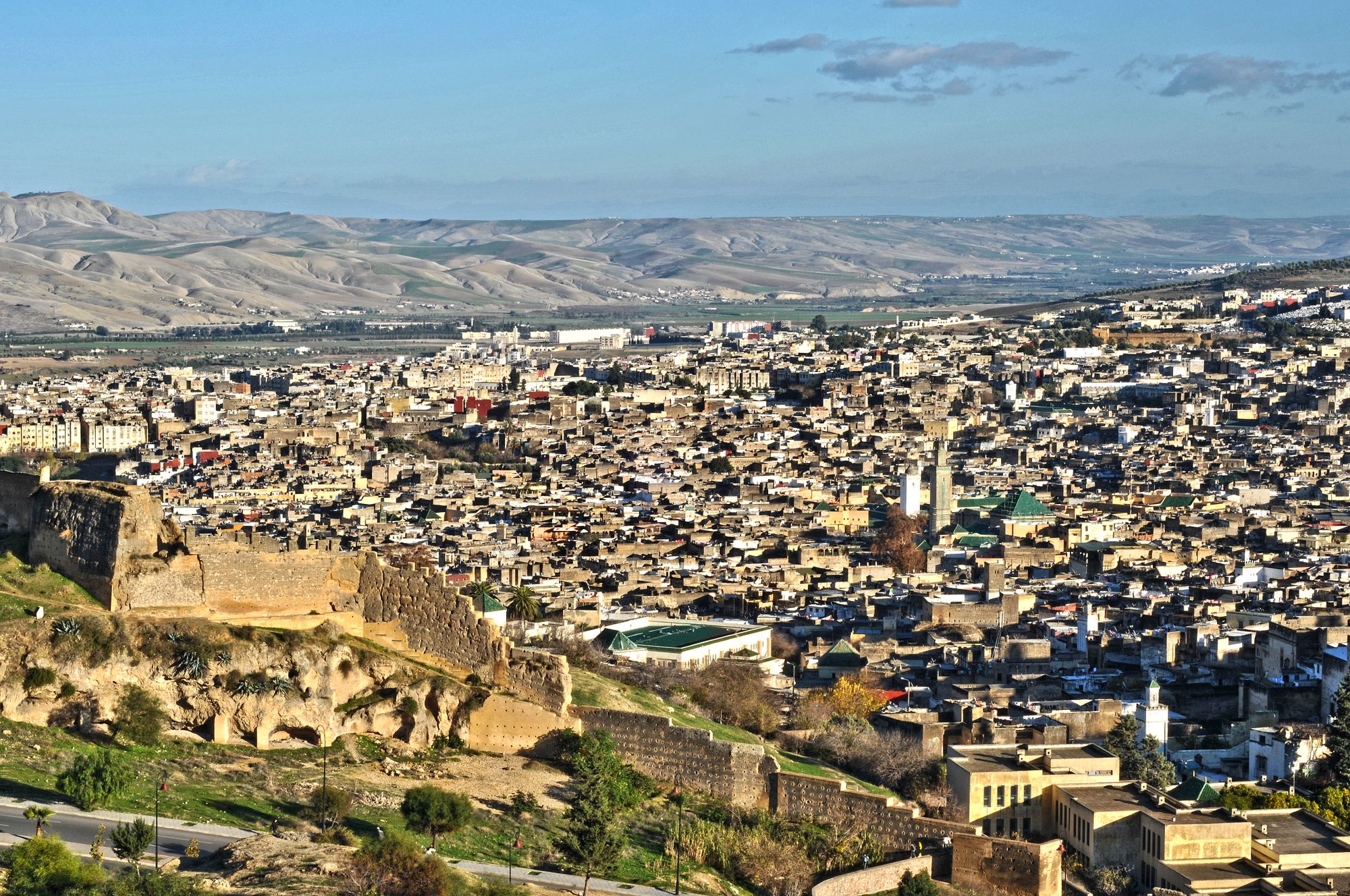
Fes el Bali is the oldest and most bewildering medina in Morocco: a UNESCO site since 1981, with donkeys hauling goods down lanes too narrow for anything else, the dye pits of the Chouara tannery, and 14th-century madrasas you can walk into for 20 MAD. Give it two full days, get properly lost at least once, and base yourself in one of the city's excellent riad hostels.
Fes is the city people mean when they say Morocco feels medieval. The old walled medina, Fes el Bali, was founded in the 9th century and is still a working city of craftsmen, mosques, schools and markets rather than a museum. It has been on the UNESCO list since 1981, and it is the place where the al-Qarawiyyin mosque and university, founded in 859, still stands at the centre of the maze.
It is also hard work. The lanes twist, dead-end and drop downhill towards the river, map apps lose the plot, and young men will offer to 'help' you the moment you look at your phone. The trick is to accept getting lost, use the two main streets (Talaa Kebira and Talaa Seghira) as your spines, and remember that walking uphill usually gets you back to Bab Boujloud, the blue-tiled gate where most visitors start.
The city has three distinct parts. Fes el Bali is the old medina and where you want to sleep. Fes el Jdid, the 'new' Fes built by the Marinids in the 13th century, holds the Royal Palace gates and the old Jewish quarter, the Mellah. The Ville Nouvelle, laid out under the French, is where you will find the train station, the CTM bus station, supermarkets, modern cafés and the few bars in town.
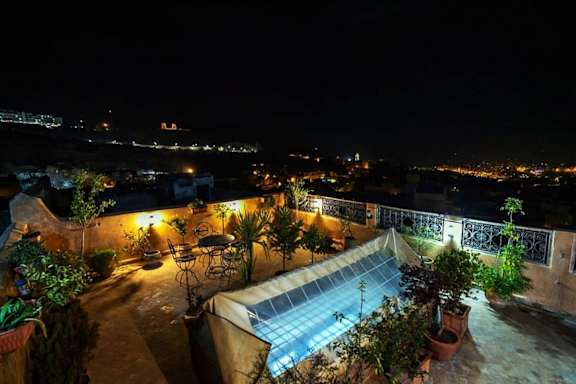
Compared with Marrakech, Fes feels less polished and less geared to tourists, which is exactly its appeal. There is no Jemaa el-Fna-style central square and evenings are quiet, so nights here are about rooftop dinners and long chats in the hostel courtyard. Fes has some of the best-reviewed hostels in the country, and that social scene is a big part of why backpackers love it.
Two full days is the sweet spot: one for the big sights (tanneries, madrasas, Nejjarine, the blue gate), one for wandering, a hammam and the Merinid Tombs at sunset. Add a third for a day trip to Meknes and the Roman ruins of Volubilis. Fes sits on the train line, so it slots easily between Chefchaouen, Tangier, Rabat and Marrakech.
Stay inside the medina, ideally near Bab Boujloud or Batha, so you can walk everywhere and still find a taxi when you need one. The Ville Nouvelle is calmer and handy for the station, but you lose the atmosphere that makes Fes worth the trip.
The blue gate at the top of the medina, with taxis outside, snack stalls and the big social hostels a few minutes away. The easiest place to find your bearings.
Just south of Bab Boujloud, by the Batha museum and a taxi rank. Close to everything but a little calmer and easier to reach with a backpack.
The heart of Fes el Bali around al-Qarawiyyin, Al-Attarine and the tanneries. Atmospheric and central, but a long walk from any taxi.
Across the river on the east side of the medina. Fewer tourists, fewer touts and a more residential feel.
The Marinid 'new town' with the Royal Palace gates, the old Jewish quarter and Jnan Sbil gardens. Few hostels, but worth an afternoon.
The French-built new town around Avenue Hassan II, near the train and CTM stations. Calmer, with supermarkets and bars, but little character.
Orange labels are neighbourhoods, dots are the 8 top-rated hostels. Map data from OpenStreetMap contributors.
Start at Bab Boujloud, the blue gate at the top of the medina, then follow Talaa Kebira downhill. This is the main artery of Fes el Bali and it takes you past spice stalls, butchers, snack stands and the Bou Inania Madrasa, a 14th-century Marinid religious school with carved cedar, stucco and zellij tilework. It is one of the few religious buildings in the city non-Muslims can enter, and the ticket is 20 MAD.
Keep going down and you reach the heart of the medina. The al-Qarawiyyin mosque is closed to non-Muslims, but you can glimpse its courtyard through the open doors. Right next to it is the Al-Attarine Madrasa (20 MAD), smaller than Bou Inania but even more intricately decorated. Nearby, the Nejjarine Museum of Wooden Arts and Crafts (20 MAD) sits in a restored caravanserai with a rooftop café, and Place Seffarine is where coppersmiths still hammer pots in the open.
The Chouara tannery is the image everyone knows: stone vats of dye and pigeon-dung lime with workers knee-deep in them. You see it from the terraces of the leather shops around it. Go in the morning, when the workers are busiest and the smell is milder. Entry to the terraces is not formally charged, but shops expect a tip of 20 to 50 MAD per person if you do not buy, and you should ignore anyone quoting 100 MAD or more. The mint sprig they hand you at the door also expects a tip.
For a view over the whole medina, walk or take a petit taxi up to the Merinid Tombs on the hill to the north, ideally at sunset when the call to prayer rolls across the city. Borj Nord, the fortress just below, has a museum of arms. Spend another afternoon in Fes el Jdid, walking past the brass doors of the Royal Palace and through the Mellah, then cooling off in the Jnan Sbil gardens.
If you want context, a licensed guide for a half day costs roughly 350 to 450 MAD and can be booked through your hostel. It is worth it for a first morning: you will see more, get lost less and be left alone by touts. Ignore anyone in the street offering to guide you.
The medina itself is the main event in Fes, and walking it costs nothing. Spend a morning on Talaa Kebira and Talaa Seghira, the two long lanes that run from Bab Boujloud down to the centre, and watch the city at work: mule trains, bakers taking trays of bread to the communal oven, and craftsmen in tiny workshops.
Bab Boujloud, the blue-and-green tiled gate, is free and the obvious photo spot; it looks best in the late afternoon. From there, the Jnan Sbil gardens are a short walk west, a shaded, well-kept park with palms, fountains and a lake that locals use to escape the heat.
Place Seffarine is a small square of coppersmiths, all noise and sparks, beside the walls of the al-Qarawiyyin library. You can stand in the doorway of al-Qarawiyyin and look in without entering. The Andalusian quarter across the river is quieter and less visited, with its own great mosque and a much calmer pace.
For the best free view in the city, climb to the Merinid Tombs above the medina for sunset. Bring water and go with others if you can: it is popular with locals in the early evening but quieter later. Fes el Jdid and the Mellah are also free to wander, and the golden doors of the Royal Palace are one of the most photographed spots in Morocco.
Fridays are the quietest day in the medina, with many shops closed around midday prayers. That makes it the easiest day to walk without hassle, though the tanneries and souks have less going on.
Fes has a strong claim to the best food in Morocco, and much of it is cheap. Start the day the local way with bissara, a thick fava bean soup drizzled with olive oil and cumin, served with bread from tiny stalls in the medina for a few dirhams. Msemen (square, flaky griddle bread) and harcha (semolina bread) with honey or cheese are the other breakfast staples.
Pastilla is the city's signature dish: a thin pastry pie filled with pigeon or chicken, almonds and spices, dusted with sugar and cinnamon. You will find it in sit-down restaurants and riad dinners rather than on the street. Khlii, preserved dried beef cooked in its own fat, is another Fes speciality, usually fried with eggs at breakfast.
For lunch, follow the queues. Small places around Bab Boujloud and along Talaa Kebira serve tagines, brochettes (grilled skewers), harira soup and sandwiches stuffed with fried fish, liver or kefta for very little. In the Ville Nouvelle, the cafés and snack bars along Avenue Hassan II are a cheaper, calmer alternative.
The rooftop restaurants near Bab Boujloud are where most travellers eat dinner. They are fine, often good, but you pay for the view, and set menus aimed at tourists can cost several times a local meal. Ask at your hostel: many cook a family-style dinner for guests at a set price, which is usually good value and the easiest way to meet people.
Alcohol is hard to find in the medina. A few hotels and restaurants are licensed, and there are bars and a supermarket with an alcohol section in the Ville Nouvelle. Mint tea, fresh orange juice and avocado smoothies fill the gap everywhere else.
Fes is not a party city. The medina has no big night square like Marrakech, alcohol is scarce, and most of the old town is in bed early. Locals spend evenings in cafés, at home or strolling around Bab Boujloud, which stays busy with snack stalls and families until late.
The real nightlife is at the hostels. Fes has some of the most social hostels in Morocco, with rooftop terraces, family dinners, games nights, live music and organised outings. If you want to meet people, pick one of the big, well-reviewed social hostels and join whatever is happening that night.
For a drink, a handful of licensed riads and restaurants in the medina serve alcohol, usually at a premium. The Ville Nouvelle has more choice: hotel bars and a few local bars around Avenue Hassan II and Avenue Mohammed V. Some are male-dominated and smoky, so go in a group if you are unsure.
Two festivals change the city completely. The Fes Festival of World Sacred Music (4 to 7 June in 2026) fills Bab Makina and the gardens with concerts, and the Festival of Sufi Culture (17 to 24 October in 2026) brings Sufi brotherhoods, poetry and late-night performances. During Ramadan, evenings are when everything comes alive, with streets full after the sunset meal.
Walking back late, stick to the main lanes, go in a group and keep a taxi number from your hostel. The medina is not especially dangerous at night, but dark, empty lanes are easy to get lost in and touts can be persistent.
Fes-Saïss Airport is about 15 km south of the city. Bus 16 runs from the airport to the main train station in the Ville Nouvelle for about 4 MAD, roughly every 30 minutes, taking 30 to 45 minutes. From the station, a red petit taxi to the medina costs around 10 to 20 MAD. A taxi straight from the airport to the medina gates usually costs 150 to 200 MAD, more at night; agree the price before you get in, or book a pick-up through your hostel.
Inside the medina you walk. Cars cannot get into Fes el Bali, so taxis drop you at gates like Bab Boujloud, Bab Guissa or Batha, and hostels often send someone to meet you there. Porters with handcarts will take your bags for a small fee. Download an offline map, but expect it to be unreliable in the tightest lanes.
Petit taxis are red, metered in theory and cheap: most rides within the city cost 10 to 25 MAD, with a 50 percent surcharge after 8 pm. Insist on the meter or agree a price first, and expect to share with other passengers going your way. Careem and inDrive work in Fes, though coverage is patchier than in Casablanca.
Fes is on the ONCF rail network. Trains to Meknes take just under an hour, to Rabat about 2½ to 3 hours, and to Marrakech around 6½ to 7 hours. For Tangier, either take the direct train (about 4 hours 40) or change at Kenitra onto the Al Boraq high-speed line (about 4 hours in total). Book on oncf-voyages.ma or at the station.
For Chefchaouen there is no train. CTM runs several buses a day from its station in the Ville Nouvelle, taking 4 to 5 hours and costing roughly €15 to €20. Book a day ahead in summer and on holiday weekends. Supratours and CTM also cover routes south towards Merzouga and the desert.
Fes is one of the cheapest cities in Morocco to sleep and eat in. At around 10.9 MAD to €1 (October 2026), a bowl of bissara costs a couple of dirhams, a sandwich or plate of brochettes 20 to 40 MAD, and a tagine in a simple local place 40 to 70 MAD. Rooftop restaurants aimed at tourists can easily charge 150 MAD or more for a set menu.
Hostel dorms in the medina generally run from about €6 to €12 a night, often with breakfast and a roof terrace. Many hostels offer a family dinner for guests at a fixed price, which is good value and saves you hunting for food on your first night.
Sights are cheap. The Bou Inania and Al-Attarine madrasas and the Nejjarine Museum each cost about 20 MAD. The tanneries are free to view, but shops expect a 20 to 50 MAD tip. A licensed guide for half a day costs about 350 to 450 MAD, which is much cheaper split between a small group.
The money traps are shopping and 'helpers'. Leather, carpets and ceramics are priced to negotiate, often starting at several times the fair price. Faux guides who lead you somewhere and then demand payment are common; agree any fee before you follow anyone.
Carry cash. ATMs are easy to find around Bab Boujloud, Batha and the Ville Nouvelle, but small shops, taxis and food stalls take only dirhams. Keep small notes and coins for tips, porters and snacks. A realistic backpacker budget, sleeping in a dorm and eating mostly local food, is about €25 to €30 a day.
Fes is generally safe, and violent crime against travellers is rare. The main problem is hassle, which is worse here than almost anywhere else in Morocco. Expect young men and teenagers to offer directions, claim a street is closed, or say the tanneries are 'this way', then expect payment. Smile, say no thank you, keep walking, and ask a shopkeeper or your hostel if you are lost.
The classic tricks are the 'closed road' (the street you are on is supposedly blocked, so you need a guide), the 'Berber market today only' line, and the free tour that ends in a carpet or leather shop. None of these are dangerous, but they waste time and money. A licensed guide carries an official badge; anyone without one is not a guide.
At the tanneries, agree how much you will tip before you go up to a terrace, and do not feel obliged to buy anything. Leather shops will try hard; prices are always negotiable, and it is fine to leave.
Pickpocketing happens in the busiest lanes and at Bab Boujloud. Keep your phone in a front pocket and your bag zipped. Late at night, the medina's back lanes are empty and poorly lit, so walk with others and use the main streets.
Women travelling alone report more comments and following in Fes than in the Ville Nouvelle or smaller towns. Covering shoulders and knees helps, as does walking with purpose and ignoring comments. Hostel staff are usually happy to walk you to the right gate or arrange a guide. In an emergency, call 19 for the police or 15 for an ambulance.
Fes is a good base for the imperial city of Meknes and the Roman ruins of Volubilis. Trains cover the first leg; grand taxis or a hired driver cover the rest.
Quieter imperial city with Bab Mansour gate, the Heri es-Souani granaries and a far more relaxed medina than Fes.
Well-preserved Roman ruins with mosaics in the open air (entry about 10 MAD per older reports), plus the hilltop holy town of Moulay Idriss nearby.
Alpine-style mountain town in the Middle Atlas and cedar forest where Barbary macaques live. A cool escape in summer.
Too far for a day trip, but the obvious next stop: plan two nights in the blue town rather than a rushed return.
Fes has two of Morocco's best-known spiritual music festivals, plus Ramadan nights that transform the medina. These are the dates to plan around.
A curated cycle of five acclaimed Spanish films comes to Fez through a collaboration between Instituto Cervantes and the Les Étoiles Cultural Center. The…
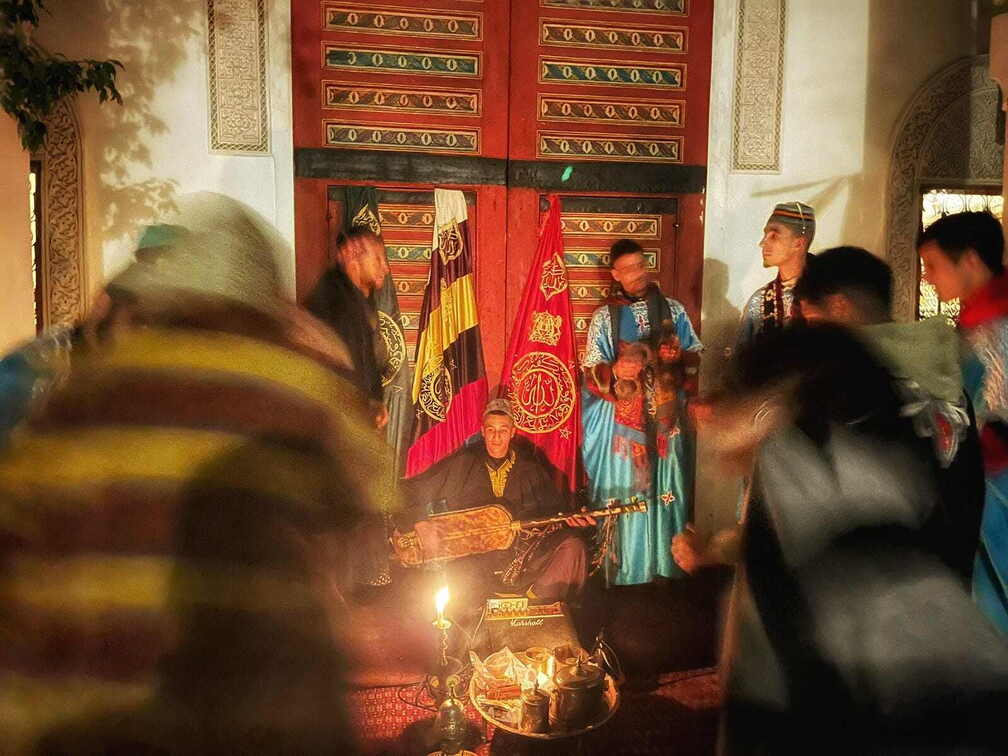
A private Gnawa lila unfolds over six hours in a traditional Fez riad, led by Maalem Fettah for no more than ten participants. This…
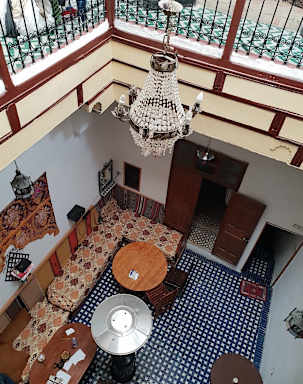
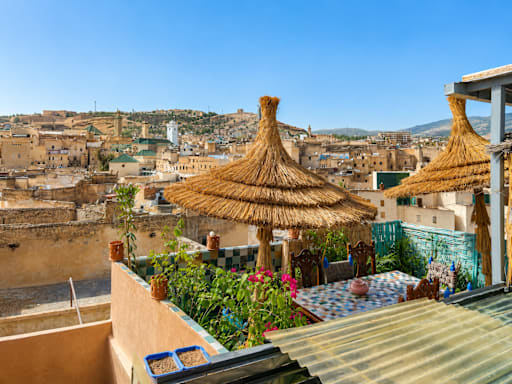
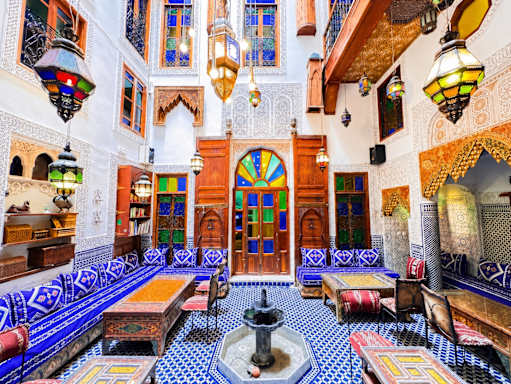
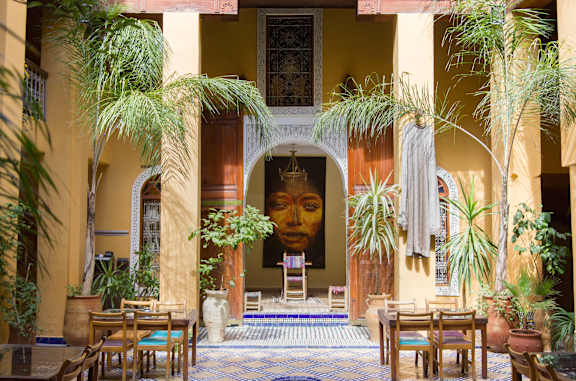
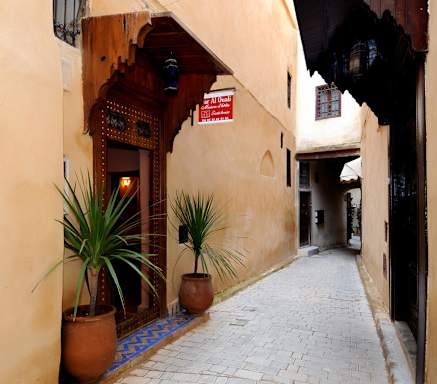
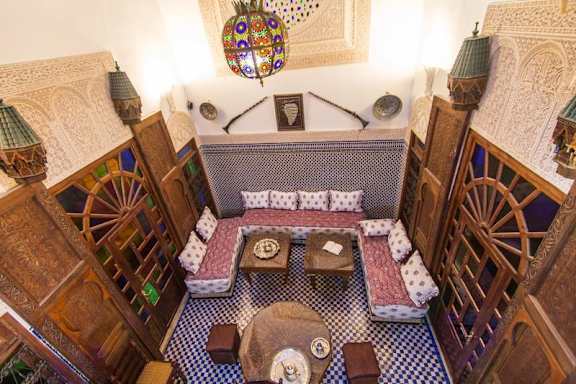
Fes hostels are mostly converted riads in the medina, with dorms around a tiled courtyard, roof terraces, breakfast included and family dinners. Several are among the best-reviewed hostels in Morocco. Live prices and reviews below.
Nearly 2,000 reviews and a 9.6 rating on Hostelworld, a medina location and a strong social programme. It also won Best Hostel in Morocco at the 2026 HOSCARs.
Over 2,100 reviews and a 9.6 rating; a busy riad hostel in Fes el Bali with a reputation for meeting people.
A 9.9 rating from more than 450 reviews, in the heart of the medina, and among the cheapest well-rated beds in town.
Spring (March to May) and autumn (late September to November) are the best times: warm days, cool nights and fewer crowds. Summer is very hot in the medina, and winter is cool, wet and quiet.
Average daily highs for Fes from avionero climate data, rounded. Nights are cold from November to March, often in single figures, and riads are rarely heated, so pack layers. Crowd numbers are our own estimate. Ramadan 2027 is expected roughly 8 February to 9 March.
Pick a style and a number of nights for a rough total. Figures are per person per day in euros: a bed, food, local transport, and sights or activities.
Our estimates at about €1 = 10.9 MAD (October 2026), built from current dorm prices, madrasa tickets and local food prices. Day trips, guides and shopping are extra.
Prices and timetables were checked in October 2026 and change often. Confirm the essentials before you travel.

Compare Fes hostels — live prices, real reviews and free cancellation on most bookings. Then meet the people already there in the app.

 Get the App.



 Get the App.