Historic centre
First visits, everything on footThe white streets around Plaza 25 de Mayo, with most hostels, museums, cafés and bars.

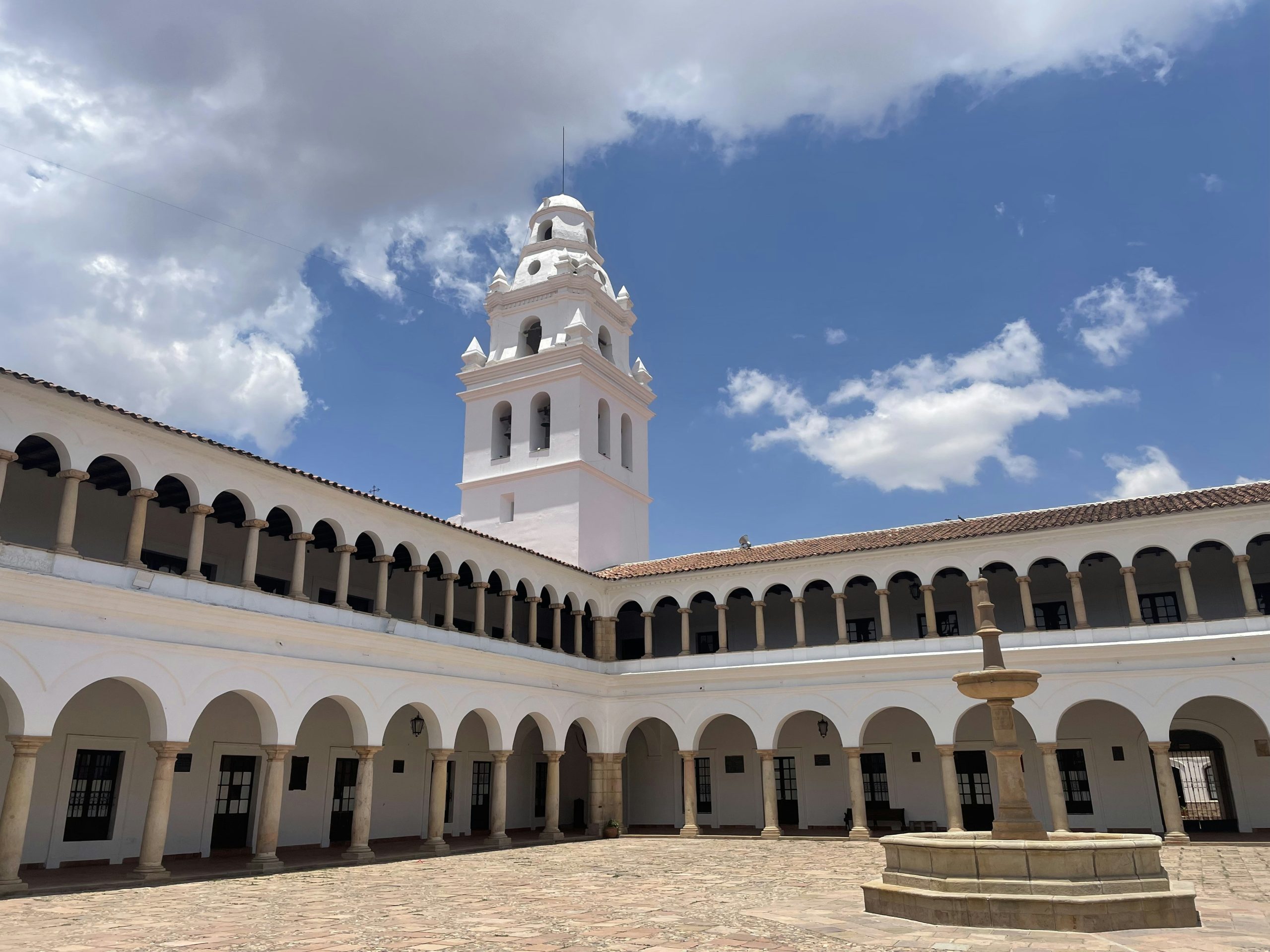
Whitewashed churches, red-tiled roofs and a mild climate at 2,800 metres. Bolivia's constitutional capital is where travellers slow down, learn Spanish and stay longer than planned.
Sucre is Bolivia's constitutional capital and its most beautiful city, a UNESCO World Heritage Site of whitewashed colonial buildings, quiet courtyards and church towers around Plaza 25 de Mayo. Bolivia declared its independence here in 1825, and the Casa de la Libertad, where the act was signed, is still on the main square.
At around 2,800 metres, it is lower and warmer than La Paz or Potosí, which makes it a welcome break from the altiplano. The pace is gentle, the university keeps the streets young, and the cafés, markets and viewpoints make it easy to fill days without trying.
Many travellers stop here for a week or more to take Spanish classes, which are some of the cheapest on the continent, or to hike in the hills around the city. Give it at least three days: one for the centre, one for the Sunday market at Tarabuco or the dinosaur footprints, and one to do nothing much at all.
The historic centre is compact and safe to walk, so stay within a few blocks of Plaza 25 de Mayo. Recoleta, up the hill, is quieter with the best view.
The white streets around Plaza 25 de Mayo, with most hostels, museums, cafés and bars.
Up the hill from the centre, with the viewpoint and the textile museum. Peaceful, and a steep walk home.
The streets around the central market, a few blocks from the plaza. Busy by day, quiet at night.
Orange labels are neighbourhoods, dots are the 5 top-rated hostels. Map data from OpenStreetMap contributors.
Start on Plaza 25 de Mayo, with the cathedral and the Casa de la Libertad, where the declaration of independence was signed and Bolivia's history is told room by room. Several churches and convents nearby let you onto their rooftops for views across the white city.
Walk up to Recoleta, a plaza with a colonnaded viewpoint over the red roofs, especially lovely at sunset, and visit the textile museum (ASUR) for the weaving traditions of the Jalq'a and Tarabuco communities. Parque Cretácico, on the edge of town, shows a quarry wall covered in thousands of dinosaur footprints, with life-size models in the park.
Further out, the Sunday market at Tarabuco is one of Bolivia's best, and the Maragua crater, a ring of coloured hills with villages and more dinosaur tracks, is a classic one- to three-day hike. And Spanish classes, usually a few hours a day with a homestay option, are the reason many travellers stay for weeks.
The white centre is free to wander, and it is the best thing to do in Sucre. Plaza 25 de Mayo is lively all day, the streets around it are full of colonial doorways and courtyards, and the climb to Recoleta gives you the city's best view for nothing.
The Mercado Central is a feast for the eyes even if you do not buy anything, with its juice stalls, piles of fruit and lunch counters. The Parque Bolívar, with its small Eiffel-style tower, is where locals spend their evenings.
Free walking tours run from the main square and are an easy introduction to the city's history.
Sucre is known across Bolivia for its chocolate, and its chocolate shops on and around the main square sell everything from bars to filled bonbons. It also claims some of the country's best salteñas, eaten mid-morning in busy salteñerías.
The Mercado Central is the place for cheap almuerzos, fresh fruit juices blended to order, and local specialities like chorizo chuquisaqueño, a spiced pork sausage. Mondongo, a pork and chilli stew, is the city's signature dish.
With so many students and long-stay travellers, Sucre also has plenty of relaxed cafés and international restaurants at low prices, plus a few bars serving singani and local craft beer.
Sucre's nightlife comes from its students. Bars around the main square and the streets just off it fill up from Thursday to Saturday, with cheap drinks, live music and a mix of locals and travellers.
The Spanish schools and hostels run social nights and salsa classes, which are the easiest way to meet people, and there are a couple of clubs for those who want to dance late.
It is lower than La Paz, so the altitude is less of a problem, but nights are still cool, so bring a layer.
The centre is compact and easy to walk, though some streets are steep. Micros (minibuses) and taxis are cheap for anything further, such as the bus terminal or Parque Cretácico, which also has its own tourist bus from the main square.
Sucre's airport, Alcantarí, is around 30km south of the city, about 40 minutes by taxi or airport bus, with flights to La Paz, Santa Cruz and Cochabamba.
The bus terminal is a short taxi ride from the centre, with overnight buses to La Paz and Cochabamba, and shorter trips to Potosí (around three hours) and Uyuni. Shared taxis to Potosí are a faster option. Check for blockades before long journeys.
Sucre is very good value. Dorm beds run from around €5 to €10, an almuerzo costs a few euros, and a juice at the market even less.
Spanish classes are the main expense for long-stay travellers, and they are some of the cheapest in South America, especially with a homestay. Day trips to Tarabuco or the Maragua crater are affordable, more so in a group.
As elsewhere in Bolivia, the exchange situation has changed a lot since 2024, so check current advice before you travel. Carry cash in small notes, as cards are not accepted everywhere.
Sucre is one of the safest cities in Bolivia and relaxed to walk around, day and night, in the centre. Take normal care with bags and phones in the market and at the bus terminal.
Use radio taxis rather than unmarked cars late at night, and be aware of the fake police scam that occasionally appears in Bolivian cities: real officers do not search you in the street.
If you hike in the hills, go with a guide or a group, as some routes are remote. In an emergency, call 110 for police or 118 for an ambulance.
Independence, the Virgin of Guadalupe and the Pujllay festival in nearby Tarabuco.
A festival of music, dance and costume celebrating a historic victory, near Sucre.
Parades and celebrations, with Sucre at the centre as the city where independence was declared.
The city's patron saint festival, with folkloric dance parades.
The highest-rated hostels in Sucre, straight from Hostelworld. Prices and availability are live on each property page.
Sucre's mild climate makes it a year-round stop. April to October is dry and sunny; November to March brings afternoon rain and greener hills.
Average highs, rounded. Nights are cool all year and chilly from June to August.
Per night, for one person, based on Sucre prices.
Treat these as a guide, as prices and exchange rates have moved a lot. Spanish classes cost extra.
The ones we get asked most.

Compare hostels in Sucre: live prices, real reviews and free cancellation on most bookings. Then meet the people already there in the app.

 Get the App.




 Get the App.